
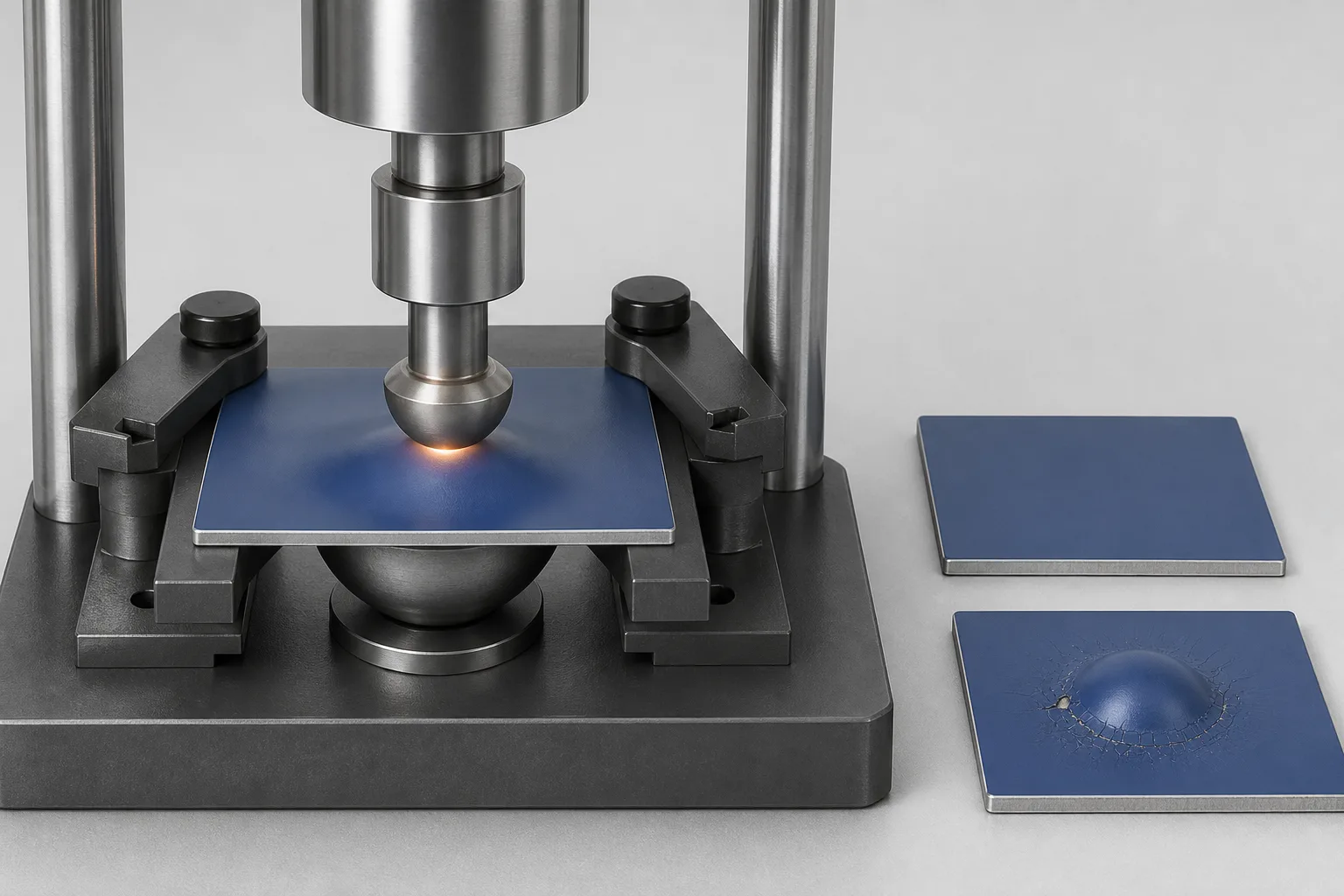
The short answer: specify a test system, not one impact number
A workable purchase or inspection clause identifies the product, applicable standard and edition, coated face and impact direction, apparatus and punch/die geometry, energy or result expression, specimen size and conditioning, substrate alloy/temper and thickness, coating construction and cure state, evaluation of cracking and pick-off, sampling, acceptance action and dispute method.
BS EN 13523-5:2014 is the current British adoption of the coil-coated-metal rapid-deformation method. Its public scope defines resistance in terms of the energy a coated metallic specimen withstands without the agreed cracking and/or pick-off outcome. The method supplies a procedure; the product or order still has to supply the limit and release rule.
| Specification field | What to agree before testing |
|---|---|
| Product and specimen | Coil or sheet identity, alloy/temper, substrate gauge, front or back coating, primer/topcoat construction, colour or texture, specimen dimensions and production or laboratory origin |
| Method and direction | Standard and edition, tested face, direct or reverse orientation as applicable, apparatus, punch/die geometry and any permitted departure from the method |
| Applied deformation | Mass and drop height or stated energy/result expression, increments, number and spacing of impacts, support condition and maximum apparatus capacity |
| Conditioning | Sample age after coating, temperature and humidity where required, surface condition, and whether the specimen has undergone representative downstream processing |
| Evaluation | Lighting, viewing or magnification, crack definition, tape and pick-off procedure when used, pass/fail or ranking rule, and treatment of substrate rupture |
| Release and dispute | Sampling by coil or lot, acceptance action, retained specimens, same-laboratory repeat and agreed referee path for a disputed result |
Choose evidence for the failure you are trying to prevent
ECCA maps EN 13523-5 to cracking and/or pick-off under rapid deformation. That makes it different from EN 13523-7 bending, which applies a slower defined fold, and from scratch methods, which evaluate surface penetration. A coating can therefore rank differently across impact, bend and scratch tests without the results contradicting one another.
ASTM D2794-93(2024) also deforms a coated substrate rapidly and evaluates the effect on the coating. ASTM states that numerical results should be restricted to one laboratory because reproducibility is poor, while ranking improves interlaboratory agreement. A buyer comparing suppliers should therefore freeze the method and laboratory route instead of treating two isolated numbers as automatically equivalent.
| Real question | Evidence that answers it |
|---|---|
| Will the coating crack or detach during a rapid local deformation? | Agreed EN 13523-5 or ASTM D2794 setup on a representative coating/substrate system, with direction, energy and evaluation recorded |
| Will the material survive a slow fold or roll-forming radius? | Use the applicable bend or representative forming evidence; do not substitute the impact result for T-bend or first-piece approval |
| Will handling or tooling scratch the surface? | Use the applicable stylus, pencil or representative process check because impact resistance is not a scratch or abrasion rating |
| Will the finished panel resist a particular dent or service impact? | Test the relevant finished construction, support and impact event; a flat coupon result alone does not establish finished-part performance |
| Can two laboratory reports be compared? | Confirm identical method, apparatus geometry, direction, specimen system, conditioning and evaluation; prefer agreed same-laboratory comparison when ASTM D2794 numerical values govern |
Use a five-step impact-acceptance workflow
- Start with the downstream risk: identify whether the concern is local rapid deformation, a slow forming radius, surface damage or a finished assembly impact, then choose the matching evidence.
- Freeze the method before production, including the edition, specimen construction, tested face, direction, apparatus geometry, energy sequence, conditioning and evaluation rule.
- Take identified samples from the agreed coil or lot and record coating age, substrate and coating construction, test setup, individual impact positions and any deviations.
- Evaluate the deformed area for the specified cracking and pick-off outcome and retain photographs, raw observations and tested coupons; do not report only the highest energy attempted.
- Release, hold or repeat according to the pre-agreed rule. If results are disputed, use retained representative material and the agreed laboratory or referee route without silently changing the setup.
Qihao perspective: connect coupon impact evidence to the forming route
From a prepainted-aluminium manufacturing and quality-communication perspective, impact testing is most useful as a controlled comparison of a defined substrate and coating stack. Changes in alloy, temper, gauge, pretreatment, primer/topcoat balance, cure, coating age or test direction can change the observed cracking or pick-off boundary.
Qihao recommends sending the end use, alloy/temper and gauge, coating construction and tested face, forming or handling risk, selected standard, proposed direction and energy expression, inspection rule, lot size and representative first-piece requirement for technical review.
This is a marked Qihao perspective based on public standards information and general manufacturing practice. It is not a claim that one impact value predicts every fabrication route or service event; the confirmed order specification and representative evidence remain controlling.
Sources
- BS EN 13523-5:2014 Coil coated metals — Test methods — Resistance to rapid deformation (impact test)British Standards Institution · 2014, current in 2026
- ASTM D2794-93(2024) Standard Test Method for Resistance of Organic Coatings to the Effects of Rapid Deformation (Impact)ASTM International · 2024
- European Tests Standards — EN 13523 method mapEuropean Coil Coating Association · Accessed 2026
Frequently asked questions
Is reverse impact resistance the same as T-bend performance?
No. An impact method applies rapid local deformation, while a T-bend applies a defined slower bend. Use the method that matches the fabrication risk and keep both results when both mechanisms matter.
Can impact values from two laboratories be compared directly?
Not without confirming the same method, apparatus, direction, specimen system, conditioning and evaluation. ASTM D2794 specifically warns of poor reproducibility for numerical values and recommends ranking to improve interlaboratory agreement.
Does passing an impact coupon test prove finished-panel dent resistance?
No. A coupon test controls rapid deformation of a defined coating/substrate system. Finished-part support, geometry and impact event can differ and need representative assembly evidence when dent performance matters.
What should be sent for an impact-resistance technical review?
Send the application, alloy/temper and gauge, coating stack and tested face, process risk, standard and edition, proposed direction and result expression, evaluation rule, lot size and representative first-piece requirement.
Related product and technical review
This article provides general information. Product availability and application-specific performance require technical confirmation.