
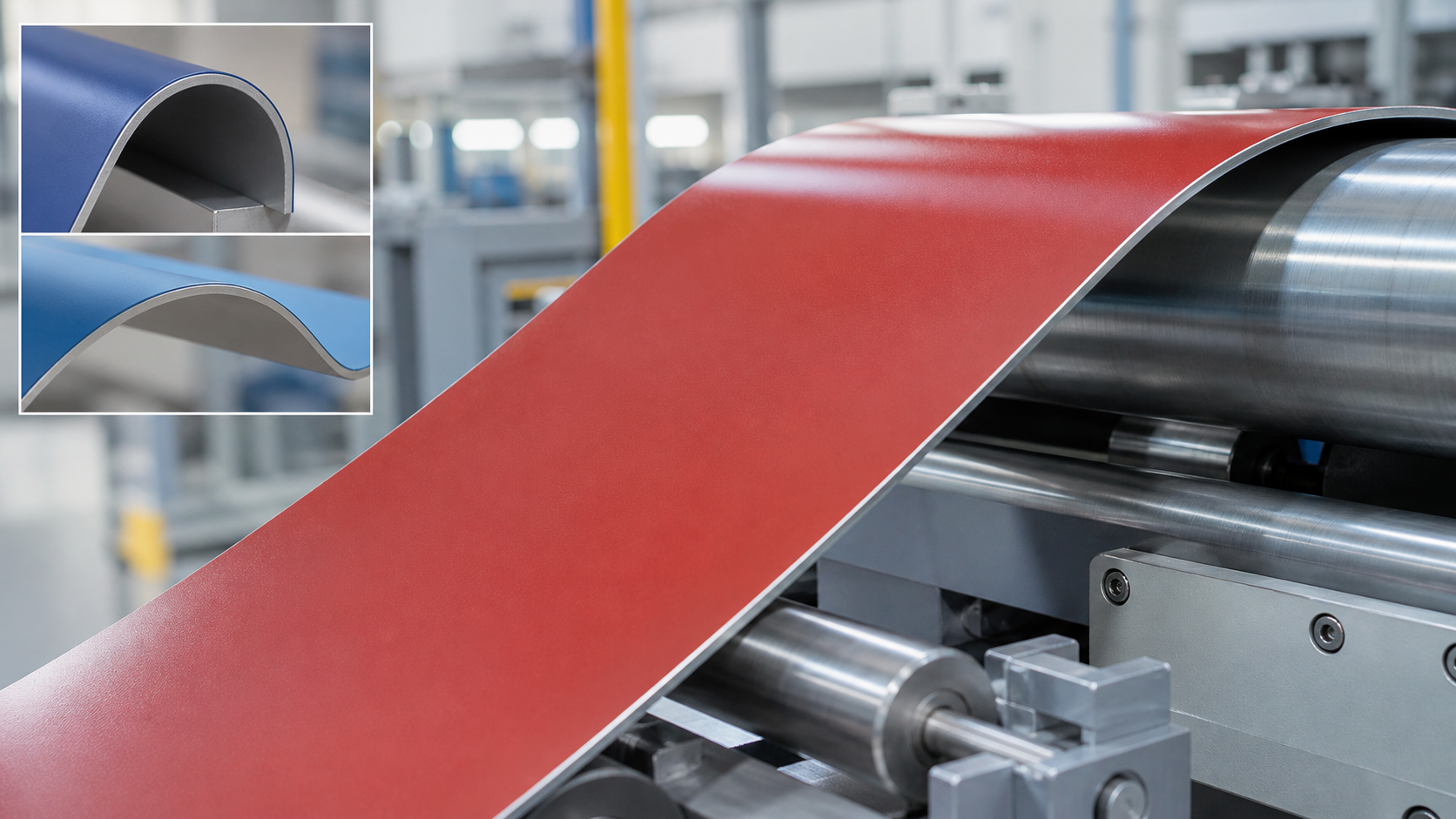
The short answer: define the forming route before the radius
“Can this prepainted aluminium be folded to 90 degrees?” hides several variables. Is the part made by a press-brake operation or continuous roll forming? Is the bend transverse or parallel to the rolling direction? Is appearance the only requirement, or must adhesion and corrosion protection remain intact? What are the tool condition and material temperature? Without those details, a single minimum inside radius is easy to misuse.
A more reliable specification connects the material to the operation: state the alloy and temper, thickness, front and back coating systems, minimum inside radius or radius-to-thickness relationship, forming direction, edge condition, tooling method and acceptance criteria. Use a same-lot trial before releasing a production quantity.
Why does the coating crack during a bend
When strip is bent, the outer arc is stretched, the inner arc is compressed and a zone near the neutral layer sees less longitudinal strain. The coating deforms with the aluminium, but its elongation, hardness, cure state and interfacial adhesion are not identical to those of the substrate. At a tight radius this can produce fine cracks, flaking or edge lift. A crack is a continuity failure in the coating; delamination is a loss of bond at the coating-substrate interface. They should be logged separately.
The cause is not always simply “paint that is too brittle.” Other contributors include an unsuitable alloy or temper, thin or locally damaged sheet, over- or under-cured coating, unstable pretreatment or cleaning, an overly tight radius, misaligned rolls, burrs, low material temperature and a change in bend direction. The same coating can therefore behave differently on different substrates, thicknesses and tools.
What T-bend, mandrel bending and production trials actually tell you
The European Coil Coating Association describes EN 13523-7 as a method for determining resistance to cracking when an organic coating is bent through 135° to 180°, with adhesion also capable of being evaluated. ASTM D4145 covers coating flexibility on prepainted sheet during fabrication such as roll forming and brake bending, and specifically notes that bend direction and specimen temperature can affect the result. The procurement lesson is straightforward: record the method and conditions, and do not interpret a lab rating outside the process it represents.
| Method or situation | Question answered and boundary |
|---|---|
| T-bend test | Folds a specimen and observes coating cracking at an agreed rating; adhesion may also be checked. Useful for comparison, but not a complete forming window for every process |
| Mandrel or cylindrical bend | Uses a defined mandrel diameter or radius for tighter geometric control; the mandrel, substrate thickness and hardness must suit the method |
| Production brake-bend or roll-forming trial | Checks the real tool, speed, direction, edges and temperature. This is the most useful confirmation before batch release |
| Appearance and adhesion review | Looks for cracking, loss of gloss, lift or exposed substrate under agreed conditions; distant visual inspection alone is insufficient |
Five groups of conditions that control forming performance
| Condition | What to confirm in procurement and process discussions |
|---|---|
| Substrate | Alloy, temper, thickness, width and rolling direction; one coating does not give every substrate the same formability |
| Coating system | Primer and topcoat chemistry, total dry-film thickness, cure state, front/back differences and forming objective |
| Interface and surface | Cleaning, pretreatment, surface defects, scratches and edge burrs; interface issues may appear as delamination after bending |
| Tooling and geometry | Minimum inside radius, brake or roll-forming method, roll gap, alignment, speed and number of forming passes |
| Environment and handling | Specimen and line temperature, handling protection, bend direction, lubrication or cleanliness and lot changes |
A six-step checklist for purchasing, trials and acceptance
- Share the final section or bend drawing, including the minimum inside radius, angle, direction, visible surface and edge requirements.
- Specify alloy and temper, thickness tolerance, front and back coating systems, film-thickness range, colour and protective-film requirements.
- Ask the supplier to state the flexibility or T-bend method, bend direction, specimen temperature, mandrel or tooling condition and the crack/delamination criteria.
- Use a same-lot specimen with the actual brake or roll-forming tool whenever possible; an informal hand fold is not a substitute for process validation.
- Under defined lighting and viewing distance, check for continuous cracks, exposed substrate, lift, obvious gloss loss or colour change on the outer bend; add magnified inspection or adhesion review when needed.
- Keep the specimen, coil number, direction, temperature, tool settings and photographs. If an issue appears, compare lot, position, direction and radius before trying to hide the cause with touch-up paint.
When a formed part cracks, start with this troubleshooting sequence
If cracks repeat at the tightest radius and in the same direction, first check radius, roll alignment, gap, material direction and temperature. If cracks appear randomly on flat areas or at contact points, check scratches, dents, coil blocking and handling damage. If the issue is limited to one lot or coil, compare coil identification, pretreatment records, cure records, film thickness and substrate temper.
Change one variable at a time during the investigation. For example, hold the tool and speed constant while comparing direction or temperature. This separates a material window from an equipment window. A larger radius, thinner film or different coating system may improve the surface, but weathering, corrosion and appearance requirements must be reconfirmed after any change.
Qihao perspective: turn “can it bend?” into a verifiable process question
From the perspective of a colour-coated aluminium manufacturer in Shandong, forming risk is often compressed into the vague phrase “the customer needs bending” during quotation. That is not enough to select material or make the supplier and downstream fabricator accountable to the same result. A stronger brief includes the section drawing, minimum inside radius, forming method, direction, visible surface and the photo standard for acceptance.
Qihao recommends treating first-piece approval as part of material acceptance: make the critical bend with the actual tool, then review appearance, adhesion and downstream assembly. If substrate, coating, film thickness, tooling or temperature changes, reassess the trial instead of carrying over an old sample conclusion.
This is Qihao’s observation and recommendation based on public standards, industry material and general manufacturing practice. It is not a performance promise for a specific product, lot, certification or bend radius. The final route must be confirmed against the selected alloy, coating system, equipment and service environment.
Boundary conditions: passing a T-bend does not make every forming operation safe
A T-bend or mandrel test evaluates a material and coating under controlled conditions. Deep drawing, stretch forming, continuous roll forming, hemming and complex cut-outs create different strain paths and local stresses. Temperature, speed, tool wear and edge quality also change the result. A rating is therefore a communication and comparison tool, not a product grade or service-life guarantee detached from the forming route.
Building envelopes, interior finishes, equipment housings and industrial components may need different combinations of forming, appearance, corrosion and weathering requirements. Standard methods help both sides use the same test language; the purchase specification, reference panel and production first piece decide release for the actual project.
Sources
- D4145 Standard Test Method for Coating Flexibility of Prepainted SheetASTM International · D4145-10(2022)
- BS EN 13523-7:2021 Coil coated metals — Resistance to cracking on bending (T-bend test)British Standards Institution · 2021
- European Tests Standards for Prepainted MetalsEuropean Coil Coating Association · Accessed 9 August 2026
- About Coil CoatingEuropean Coil Coating Association · Accessed 9 August 2026
Frequently asked questions
Does a 0T result mean the coating will never crack at any radius?
No. 0T is a result from a defined specimen, direction, temperature and method. It does not automatically cover every thickness, substrate, tool or shop-floor temperature. The actual material and forming tool still need a first-piece trial.
Why can the same coil form differently at two fabricators?
Roll alignment, gap, minimum radius, forming passes, speed, bend direction, material temperature, edge condition and handling protection may differ. Align the process conditions before comparing material performance.
Does a thinner coating always bend more safely?
Not necessarily. Forming performance also depends on resin chemistry, pigments, cure, pretreatment, substrate and bend strain. Judge the agreed film-thickness range together with an actual forming trial.
What bending information should a buyer confirm before ordering prepainted aluminium?
At minimum: alloy and temper, thickness, front and back coating systems, minimum inside radius, forming method and direction, specimen temperature, test method, and criteria for cracks, delamination and appearance defects.
This article provides general information. Product availability and application-specific performance require technical confirmation.