
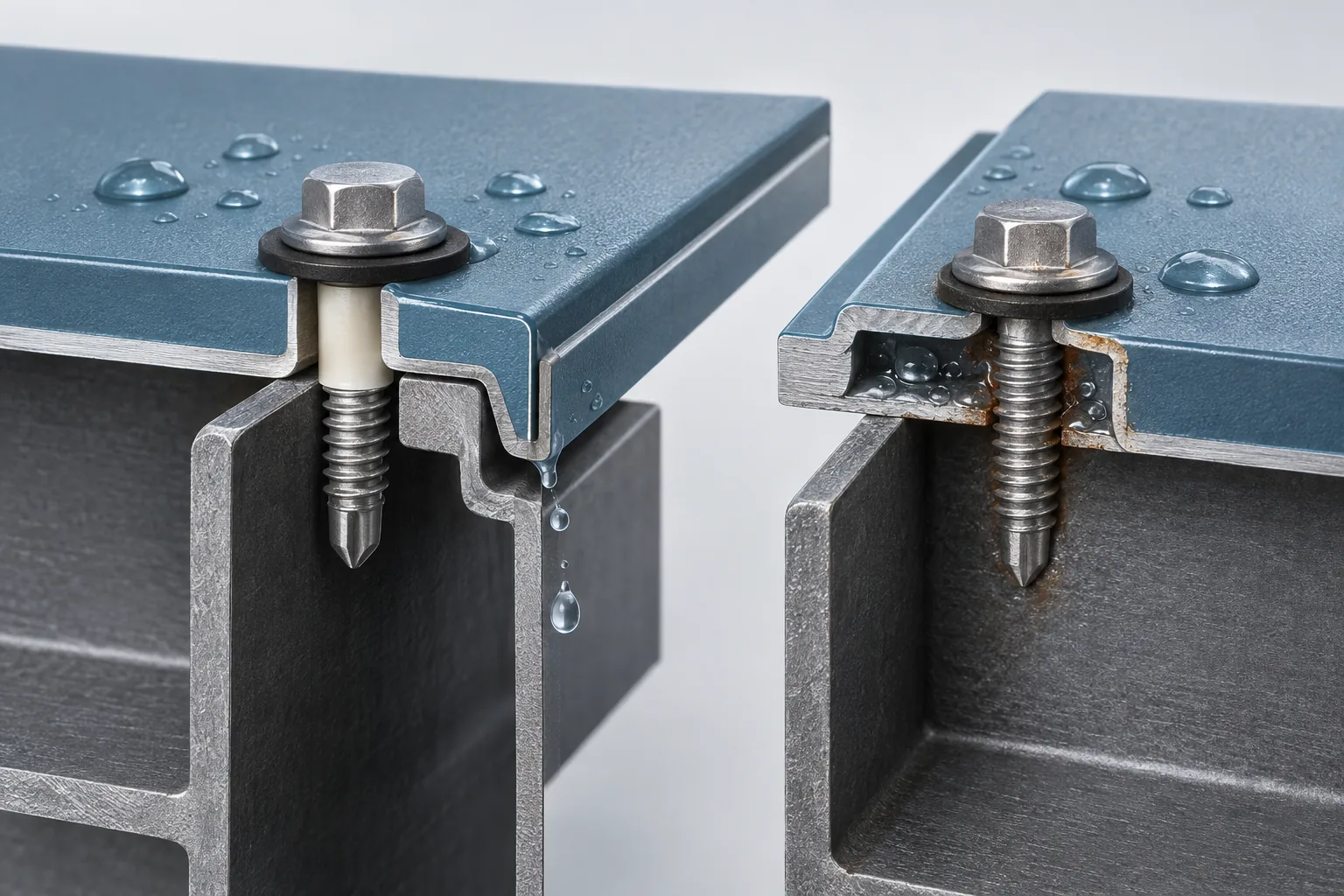
The short answer: specify the joint, not a generic screw
Record the panel alloy and temper, coating system and back coat, fastener body, head and surface treatment, washer or cap, support metal, sealant or isolation layer, hole preparation, exposed edges, expected water and salt exposure, drainage path and installation method. Then assign who approves structural capacity, watertightness, fire implications, material compatibility and any replacement interval.
FGIA's active AAMA TIR-A9-14 is specifically intended to help metal curtain-wall designers select fasteners for framing members, components and anchors. The Aluminum Association likewise states that fastener selection depends on strength, service conditions, removability and intended service life. Those are reasons to define project evidence, not to copy one metal pairing into every facade detail.
Use a joint-risk matrix before approving a fastener
| Input to freeze | Evidence or action to request |
|---|---|
| All metals and finishes | Identify the aluminium substrate and coating, fastener body/head finish, washer or cap and support metal; review the actual pairing rather than a catalogue family name. |
| Electrical contact | Show whether a durable non-conductive washer, sleeve, tape or coating interrupts the path, including what happens after tightening, movement and maintenance. |
| Water, salts and drainage | Map rain, condensation, cleaning water, marine or industrial deposits and run-off; detail drainage and avoid pockets that retain contaminated moisture. |
| Holes, cuts and damage | Define drilling and deburring, swarf removal, treatment of exposed edges and inspection of coating damage around penetrations. |
| System performance | Link the representative joint to structural, pull-out, movement, water, fire and corrosion evidence required by the responsible designer and local rules. |
| Installation and replacement | Specify approved components, setting method or torque where applicable, inspection points, traceability, access and the rule for replacing damaged or substituted parts. |
Understand the two moisture-related failure paths
Galvanic corrosion requires three conditions at once: dissimilar metals with a sufficient potential difference, electrical continuity and an electrolyte such as a water film. Breaking durable electrical contact, choosing a reviewed pairing or excluding and draining the electrolyte can reduce the risk. Paint alone should not automatically be treated as lifetime isolation because it can be damaged at holes or by the fastener itself.
Crevice corrosion is a different mechanism. Tight gaps under washers, caps, laps or sealant defects can retain moisture and salts even when the metal pairing appears acceptable. A detail can therefore need both compatibility control and a water-management review. Stainless steel is not automatically safe or unsafe: exposure, contact area, isolation, joint geometry and the specific product all matter.
A six-step specification and acceptance workflow
- List the panel, support, fastener, washer, cap, isolator and sealant by material and finish, including substitutions that are not allowed without review.
- Map direct contact, run-off and trapped-water paths on the drawing; identify marine salts, industrial deposits, condensation and sheltered zones.
- Select and document durable isolation, edge protection and drainage measures for the real geometry, while checking movement and sealant compatibility.
- Obtain structural, water, fire and corrosion evidence at the level required by the project; a coated-metal coupon or salt-spray hour alone does not qualify the assembled joint.
- Approve a representative installed detail, including hole quality, swarf removal, coating damage, component seating and any controlled tightening requirement.
- Inspect the first installation and sampled production work, record substitutions or damage, and define maintenance access and replacement criteria.
Qihao perspective: keep coil identity connected to the joint detail
From a prepainted-aluminium manufacturing and quality-communication perspective, the joint review is stronger when the coil or panel record identifies the substrate, coating build, front and back surfaces and intended forming or drilling route. That helps the project team distinguish an intact factory finish from cut edges, holes, swarf damage and site-applied barriers.
For an enquiry, send the panel alloy/temper and thickness, coating system, fastener and support-metal specification, washer/isolator/sealant, section drawing, exposure and drainage, performance requirements, installation method and proposed evidence. Qihao can review declared material and coating inputs; final fastener selection, joint engineering, waterproofing, fire and structural approval remain with the responsible designers and component suppliers.
Boundaries
This guide is a procurement and design-review framework, not a project fastener approval or service-life promise. Codes, structural loads, fire strategy, facade testing, sealants, local exposure and proprietary component instructions can change the acceptable assembly. Confirm the completed detail with the responsible facade engineer, fastener and sealant suppliers and applicable authority.
Sources
- AAMA TIR-A9-14 Design Guide for Metal Cladding FastenersFenestration and Glazing Industry Alliance · 2014, 2020 addendum
- Designing Aluminum Structures FAQsThe Aluminum Association · 2020-10-12
- Long lasting prepainted metalEuropean Coil Coating Association · Accessed 2026
- Compatibility of aluminium and steelBRANZ · 2020-02-01
Frequently asked questions
Is stainless steel always the safest fastener for aluminium?
No. Review the exact grade and finish, exposure, electrical contact, relative areas, joint geometry, isolation and project requirements with the responsible specialists.
Is the panel paint enough to isolate two metals?
Do not assume so. Drilling, tightening, movement and ageing can damage a coating; show how durable electrical isolation is maintained in the completed joint.
Do salt-spray hours prove the facade joint will last?
No. Coupon tests can compare defined coating systems, but they do not alone reproduce the assembled metals, crevices, loading, installation damage, drainage or service environment.
What should happen at drilled holes and cut edges?
Define deburring, swarf removal, exposed-edge treatment, coating-damage inspection and any approved repair method before installation starts.
What should a buyer send for fastener review?
Send the full material stack, section drawing, exposure and water paths, performance requirements, installation method, proposed substitutions and the evidence required for acceptance.
Related product and technical review
This article provides general information. Product availability and application-specific performance require technical confirmation.