
The short answer: specify the exposure and the decision rule
A workable purchase or inspection clause identifies the product and coating system, applicable standard and edition, tested face, edge and scribe treatment, specimen conditioning, exposure mode, temperature and duration, inspection timing, assessment method, permissible blistering or corrosion, sampling, batch action and dispute route. Writing only 'humidity resistance: 1,000 hours' leaves the most important comparison conditions undefined.
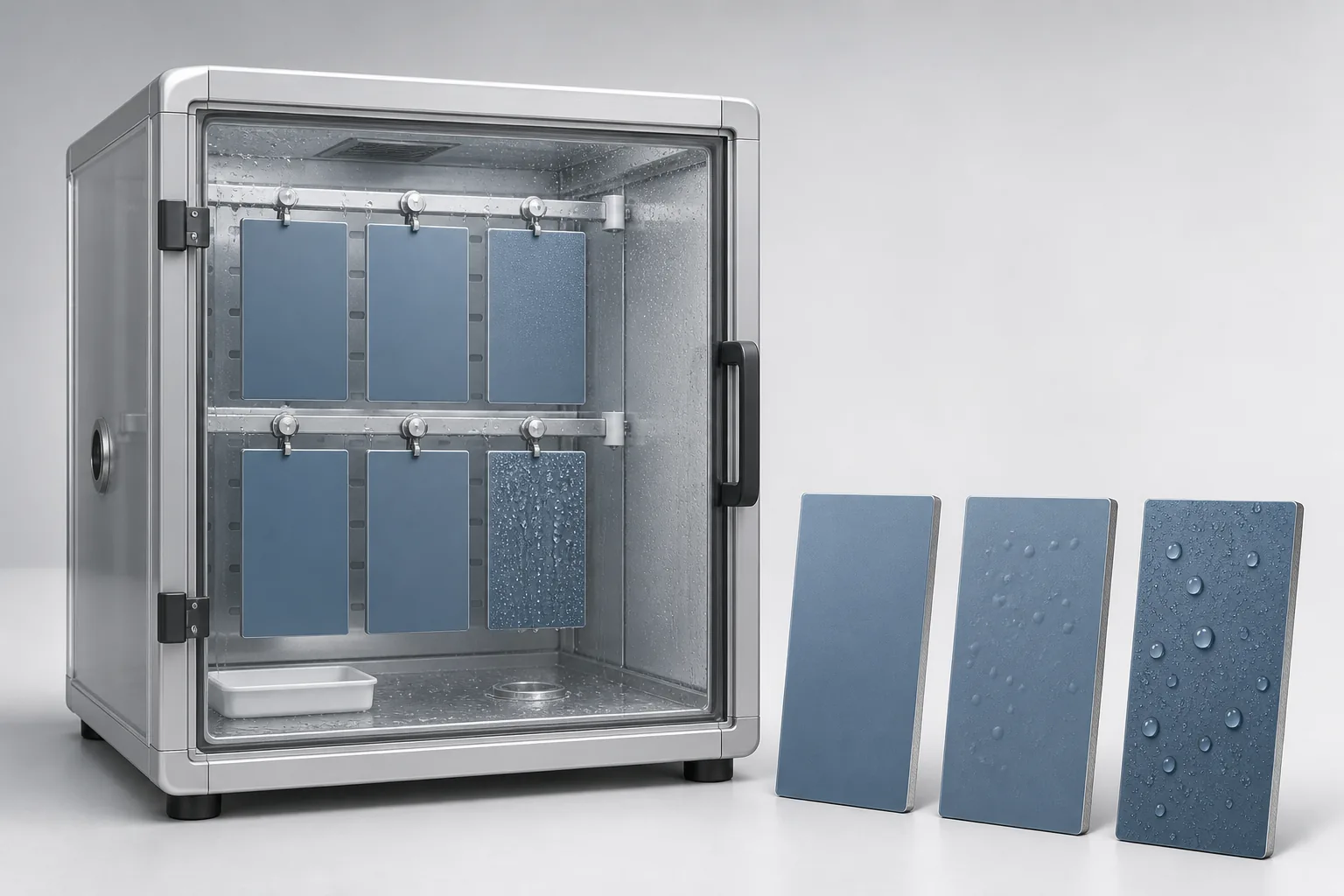
BS EN 13523-25:2022 is the current British adoption for evaluating an organic coating on a metallic substrate in a controlled humidity cabinet and permits continuous or cyclic humidity tests. BS EN 13523-26:2022 is the current route for continuous water condensation on coil-coated metal. The applicable product specification or order still has to supply the exposure period and acceptance limit.
| Specification field | What to agree before testing |
|---|---|
| Product and specimen | Coil or sheet identity, aluminium alloy/temper and gauge, pretreatment, primer/topcoat/backcoat construction, colour or texture, production or laboratory origin and specimen dimensions |
| Exposed condition | Tested face, edge sealing or exposure, scribe or other artificial defect where applicable, flat or representative formed specimen and any cut-edge or joint detail |
| Method and regime | Standard and edition, humidity or condensation route, continuous or cyclic operation, cabinet set point, water requirement, orientation and permitted interruption |
| Time and inspections | Exposure duration, interim inspection points, point in a cycle when examined, handling of surface moisture and timing of final evaluation |
| Assessment | Blister size and density, corrosion or coating change, colour/gloss or adhesion check when required, photography and agreed permissible result |
| Release and dispute | Samples per coil or lot, pass/hold/retest action, retained controls, repeat conditions and agreed referee laboratory or method |
Choose the method by the moisture mechanism
ECCA lists humidity and water-condensation resistance as separate parts of EN 13523. Part 25 exposes the coated specimen in a controlled humidity cabinet; Part 26 evaluates continuous condensation and may assess blistering, colour and gloss changes. ASTM D2247-25 creates condensation on all specimen surfaces in 100% relative humidity and explicitly does not specify specimen preparation or result evaluation. A method name therefore cannot stand alone as a product requirement.
Humidity evidence is also different from salt spray, immersion and UV-plus-condensation. Salt fog introduces a defined salt environment, immersion keeps the coating in water, and accelerated weathering combines other stresses. Select one or more only when each answers a real exposure or failure question; do not assemble a generic test bundle without a decision purpose.
| Buyer or application question | Evidence route to consider |
|---|---|
| Will the complete coating system resist a controlled humid atmosphere? | Use the applicable EN 13523-25 humidity regime or product-specific requirement, with specimen, duration and evaluation fixed |
| Will continuous surface condensation change the coating? | Use EN 13523-26 when continuous water condensation and changes such as blistering, colour or gloss are the intended evidence |
| Does a specification call for 100% relative humidity on the whole specimen? | Use ASTM D2247 only with a material or order-specific duration, specimen preparation and acceptance rule |
| Is chloride, immersion or UV/weathering the actual risk? | Select the matching corrosion, immersion or weathering method; humidity hours are not a substitute for those mechanisms |
| Must a formed panel, bonded assembly or cut edge perform? | Add a representative processed or assembled specimen because a pristine flat coupon does not reproduce every interface and geometry |
Use a five-step humidity-acceptance workflow
- Map the moisture exposure first: indoor humidity, repeated dew, sheltered exterior condensation, wash water, trapped interfaces, cut edges and temperature cycling lead to different evidence needs.
- Freeze the method, edition, specimen stack, exposed face and edges, artificial defects, regime, duration, inspection timing and assessment scale before production samples enter the cabinet.
- Identify specimens by coil or lot and record substrate, coating construction, cure age, any forming or bonding, cabinet conditions, interruptions, controls and individual panel positions.
- Inspect at the agreed points and record the named outcomes. ASTM D714-25 can describe blister size and density, but the purchaser and seller must still agree the permissible degree when it is used for performance acceptance.
- Release, hold or repeat according to the written rule. When a result is disputed, use retained representative material and the same documented exposure and evaluation route instead of switching methods after the test.
Qihao perspective: test the interfaces that will actually stay wet
From a prepainted-aluminium manufacturing and quality-communication perspective, humidity testing is most informative when the coupon represents the interfaces that matter: pretreatment-to-primer, primer-to-topcoat, backcoat-to-adhesive or core, and cut or formed areas that may hold moisture. A decorative face can remain visually sound while an unrepresented edge or bonded interface controls the application risk.
Qihao recommends sending the end use, indoor or outdoor exposure, condensation pattern, cleaning or chemical contact, alloy/temper and gauge, coating construction on both faces, edge and joint design, forming or bonding route, selected method, required duration, assessment limit, lot size and representative-part requirement for technical review.
This is a marked Qihao perspective based on public standards information and general manufacturing practice. It is not a company performance promise or a claim that cabinet hours predict service life; the confirmed order specification and representative evidence remain controlling.
Sources
- BS EN 13523-25:2022 Coil coated metals — Test methods — Resistance to humidityBritish Standards Institution · 2022, current in 2026
- BS EN 13523-26:2022 Coil coated metals — Test methods — Resistance to condensation of waterBritish Standards Institution · 2022, current in 2026
- ASTM D2247-25 Standard Practice for Testing Water Resistance of Coatings in 100% Relative HumidityASTM International · 2025
- ASTM D714-25 Standard Test Method for Evaluating Degree of Blistering of PaintsASTM International · 2025
- European Tests Standards — EN 13523 test-method mapEuropean Coil Coating Association · Accessed in 2026
Frequently asked questions
Are EN 13523-25 and EN 13523-26 interchangeable?
No. Part 25 covers controlled humidity exposure and allows continuous or cyclic testing; Part 26 addresses continuous water condensation. Use the method named by the applicable product specification or the one agreed for the actual evidence question.
Does 1,000 hours in a humidity cabinet equal a number of service years?
No direct conversion should be claimed without a demonstrated quantitative correlation for the coating system and environment. ASTM D2247 expressly warns against representing the test as an equivalent period of natural water exposure.
Is 'no blistering' a complete acceptance clause?
Not by itself. State the assessment method and timing, permissible blister size and density or other agreed rating, the area and edges assessed, and the action for a nonconforming specimen.
What should be sent for a humidity-resistance technical review?
Send the use environment, condensation and cleaning pattern, alloy/temper and gauge, coating construction on both faces, edge/joint and forming or bonding details, proposed method and duration, assessment limit, lot size and representative-part requirement.
Related product and technical review
This article provides general information. Product availability and application-specific performance require technical confirmation.