
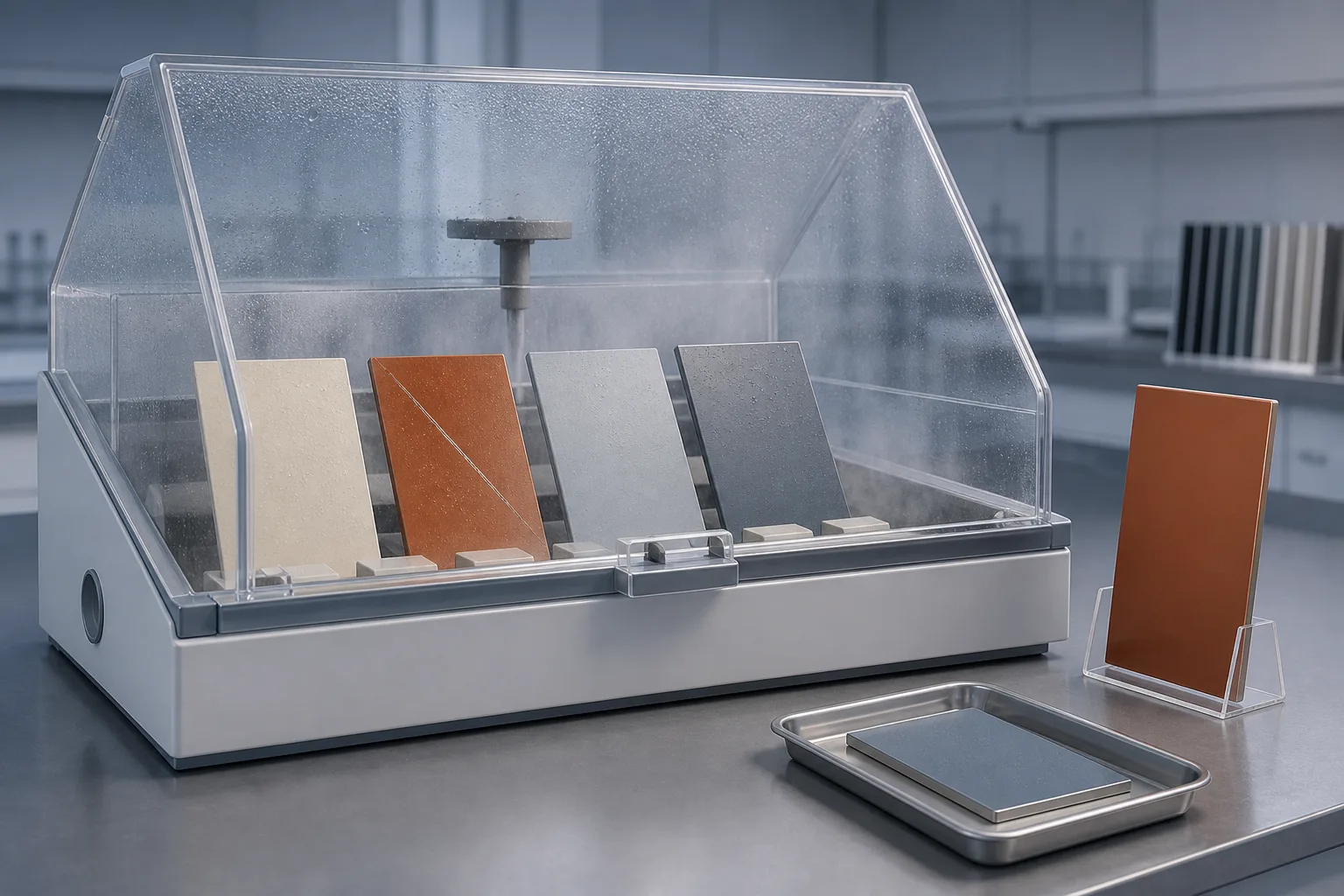
The short answer: specify the whole evidence chain
A workable clause answers seven questions: which standard and edition applies, which salt-fog environment is used, what production material becomes the specimen, whether an artificial defect is made, how cut edges and the back are treated, how long and under what conditions exposure runs, and how blistering, corrosion or delamination are assessed for release. Without those fields, two laboratories can both follow a recognised chamber practice and still produce results that do not answer the same purchase question.
EN 13523-8:2024 is specific to organic coatings on coil-coated metallic substrates. Its public scope notes that neutral salt spray is usually used for steel and acetic acid salt spray for aluminium. ISO 9227:2022 covers NSS, AASS and CASS apparatus and procedures more generally, but explicitly leaves specimen type, exposure period and interpretation to the relevant product specification. The substrate name alone therefore does not justify copying a familiar NSS-hour clause into every prepainted-aluminium order.
| Specification field | Decision to record |
|---|---|
| Purpose and applicable document | State whether the test supports coating-system qualification, process consistency, batch release or investigation; name the governing product/test standard and edition |
| Exposure environment | Name NSS, AASS or another agreed method and why it represents the applicable product requirement; do not use the words ‘salt spray’ alone |
| Specimen | Identify alloy/temper, gauge, pretreatment, primer/topcoat/backcoat, colour, film construction, production lot, panel size, orientation and conditioning |
| Artificial defect and edges | Define scribe geometry and location, whether the field is also assessed, and how cut edges, holes, back face and formed areas are exposed or protected |
| Exposure and interruptions | State the agreed duration, inspection points, handling of interruptions and any removal/cleaning procedure required before assessment |
| Assessment and release | Name the rating methods, locations, limits for blistering/corrosion/delamination, repeat or referee rule, retained sample and disposition of a failed lot |
A chamber practice does not create the acceptance limit
ASTM B117-26 describes how to create and control a salt-fog environment. ASTM states that the practice does not prescribe a product's specimen type, exposure period or result interpretation, and warns that stand-alone salt-spray performance seldom predicts natural-environment performance. ISO 9227 makes the same boundary explicit and says the methods are useful for checking maintained quality and detecting coating discontinuities, not for ranking different materials or predicting long-term corrosion resistance.
That boundary changes procurement language. ‘Pass ASTM B117 for 1,000 hours’ still lacks an agreed specimen, defect state and failure criterion. A report that records only ‘no red rust’ may also be poorly matched to an aluminium substrate. The parties need to define what is observed on the face, around a scribe, at edges and at any formed area, using criteria appropriate to the selected product system.
Use a five-step approval and release workflow
- Map the real exposure first: chloride source, wet/dry pattern, sheltered condensation, cut edges, joints, dissimilar-metal contact, cleaning and maintenance. Decide whether salt fog is relevant and whether another product-specific or cyclic method is needed.
- Select the governing product specification, then the named test method and current agreed edition. ISO/TR 16335:2013 frames method selection around intended application and product qualification rather than one universal accelerated test.
- Approve a production-representative panel plan before the test. Photograph and identify the face, scribe, edges, back, formed features and retained control sample.
- Issue a complete report: lot and construction, specimen preparation, chamber method, exposure record, interruptions, assessment procedure, raw observations, ratings, photographs and any deviations.
- Apply the pre-agreed decision: release, hold and repeat under the referee plan, or investigate. Do not change the limit after seeing the result, and requalify when a material or process change affects the evidence chain.
Qihao perspective: separate material evidence from detail risk
From a prepainted-aluminium manufacturing and quality-communication perspective, a clean flat-panel result cannot by itself release a formed part with exposed cut edges, tight joints or incompatible fasteners. The panel can evidence the named coating construction under the named method; fabrication details and assembled exposure remain separate engineering risks.
Qihao recommends sending the application and exposure description, applicable product standard, alloy/temper and gauge, coating construction and colour, part drawing, visible face, cut-edge and joint design, specimen plan, required ratings and release rule before testing. That prevents a laboratory certificate from arriving after the parties have formed different expectations.
This is a marked Qihao perspective based on public standards information and general manufacturing practice. It is not a corrosion-duration, service-life or order-specific performance promise; the confirmed specification, representative evidence and project review remain controlling.
Sources
- EN 13523-8:2024 Coil coated metals — Test methods — Resistance to salt spray (fog)DIN Media · 2024
- ISO 9227:2022 Corrosion tests in artificial atmospheres — Salt spray testsInternational Organization for Standardization · 2022
- ASTM B117-26 Standard Practice for Operating Salt Spray (Fog) ApparatusASTM International · 2026
- ISO/TR 16335:2013 Guidelines for selection of accelerated corrosion tests for product qualificationInternational Organization for Standardization · 2013
- European coil-coated metal test methodsEuropean Coil Coating Association · Accessed 21 August 2026
Frequently asked questions
Should prepainted aluminium always be tested with neutral salt spray?
No universal choice follows from the substrate name alone. EN 13523-8:2024 notes AASS is usually used for aluminium, while ISO 9227 covers several environments. Select the method required by the applicable product specification and intended exposure, then agree all specimen and assessment details.
Does a longer salt-spray result prove a longer outdoor life?
No direct conversion is supported. ASTM B117 and ISO 9227 both define controlled test environments and caution against stand-alone prediction of natural exposure. Service performance also depends on design, edges, joints, environment, maintenance and corroborating evidence.
Is ‘no corrosion after 1,000 hours’ a complete acceptance clause?
No. It omits the salt-fog type, specimen construction, scribe and edge state, conditioning, inspection and cleaning procedure, rating method, observation zone, numerical or visual limits and release action.
What should a buyer send for a corrosion-test review?
Send the application and exposure, product standard, alloy/temper and gauge, coating build and colour, part drawing, visible face, edge and joint details, specimen plan, selected method, ratings and release rule.
Related product and technical review
This article provides general information. Product availability and application-specific performance require technical confirmation.