
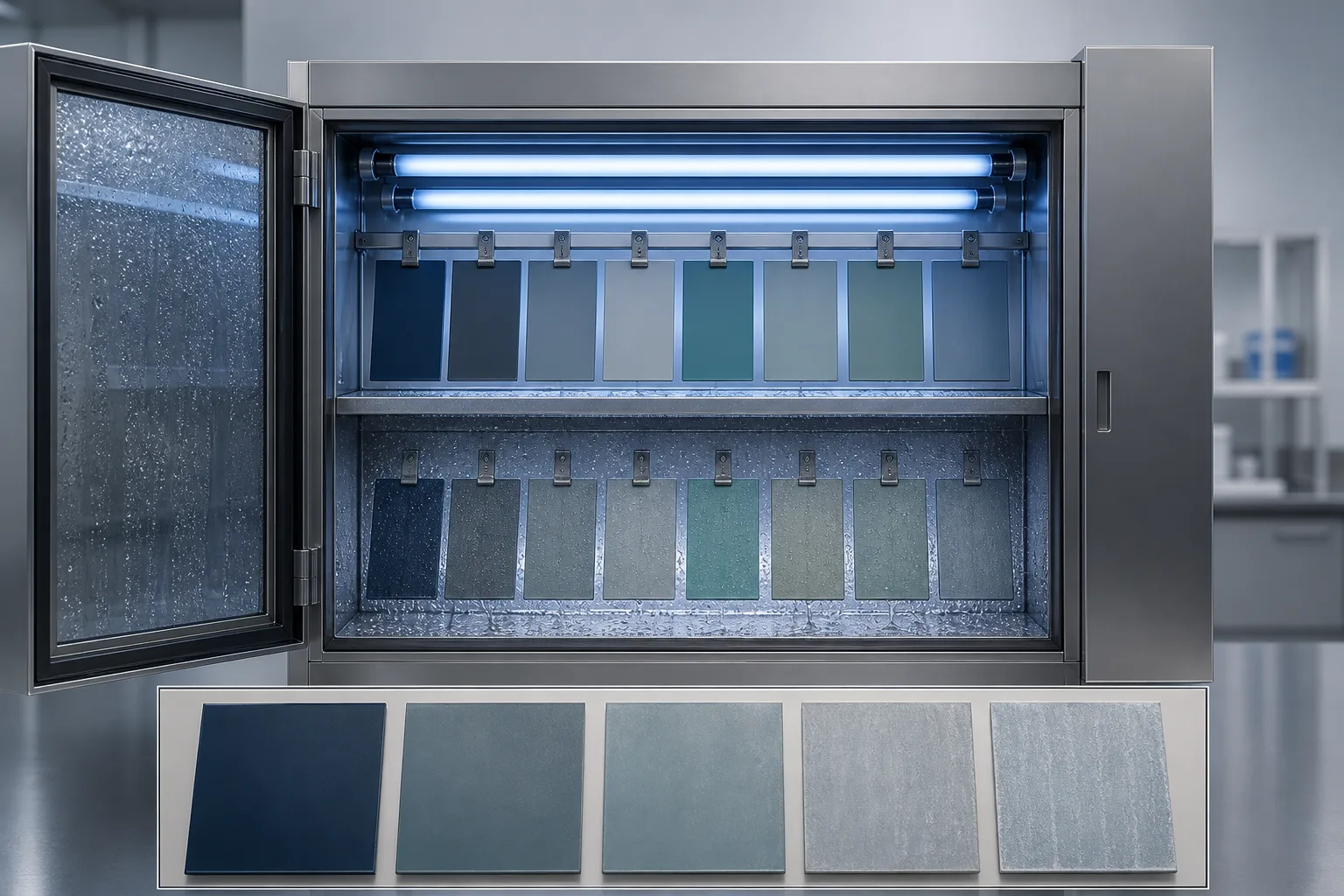
The short answer: specify the whole exposure-and-decision protocol
A workable purchase or inspection clause identifies the prepainted aluminium system, standard and edition, fluorescent lamp type, irradiance and control point, UV and condensation or water cycle, temperatures, water quality, specimen orientation, exposure duration, inspection intervals, conditioning, reference control, assessment methods, permissible changes, sampling, batch action and dispute route. 'UV resistance: 2,000 hours' leaves the comparison conditions and release decision undefined.
BS EN 13523-10:2024 is the current British adoption for resistance of coil-coated metals to fluorescent UV radiation and water condensation. ISO 16474-3:2021 covers fluorescent UV, heat and water exposures for coatings more generally. The applicable product specification or order still has to select the conditions and acceptance limits; neither title supplies a universal durability promise.
| Specification field | What to agree before testing |
|---|---|
| Product and specimen | Coil or sheet identity, alloy/temper and gauge, pretreatment, primer/topcoat/backcoat, colour or texture, tested face, edges, flat or representative formed condition and specimen age |
| Apparatus and source | Standard and edition, fluorescent lamp type, apparatus model where relevant, irradiance control and calibration or lamp-change records required by the method |
| Cycle | UV and condensation or water sequence, black-panel or chamber temperatures, humidity or water condition, cycle count, permitted interruptions and specimen repositioning |
| Time and controls | Total exposure, interim inspections, evaluation point within the cycle, replicate count and a concurrently exposed control or approved reference panel |
| Assessment | Colour difference, gloss change, chalking, blistering, cracking, adhesion or other application-relevant properties, including instruments, timing and permissible limits |
| Release and dispute | Samples per lot, pass/hold/retest action, retained specimens, repeat conditions and agreed referee laboratory or comparison route |
Choose the method by the degradation question
ECCA maps fluorescent UV and water condensation for coil-coated metals to EN 13523-10. ISO 16474-3 describes controlled fluorescent UV, heat and water exposure for coatings. ASTM D4587-23 selects conditions for fluorescent UV-condensation exposure of paints and related coatings and requires the test cycle and equipment to be reported; ASTM G154-23 governs operation of the apparatus but states that it does not, by itself, deliver a material-specific result.
These methods can accelerate selected effects of ultraviolet radiation, moisture and heat, but they do not reproduce every outdoor mechanism. Salt, pollution, wet-dry corrosion, installation geometry, shelter, cleaning and local microclimate require separate evidence where they control the application.
| Buyer or design question | Evidence route to consider |
|---|---|
| Will two coating systems retain appearance under the same UV-moisture cycle? | Expose representative systems and a control under one defined EN 13523-10, ISO 16474-3 or ASTM D4587 protocol, then compare agreed colour, gloss and chalking results |
| Is moisture alone the concern? | Use the applicable humidity or condensation method; adding UV changes the stress and the evidence question |
| Is full-spectrum daylight or a glazing condition important? | Review whether a xenon-arc or other application-specific method is more representative instead of assuming fluorescent UV is interchangeable |
| Is chloride or cut-edge corrosion the concern? | Use the applicable corrosion method and representative edge or assembly; UV-condensation is not a salt-fog substitute |
| Is a service-life warranty or project durability decision required? | Combine the order-specific coating specification with relevant laboratory comparison, natural exposure or field evidence and project conditions; do not use an hour-to-year formula |
Use a five-step approval and release workflow
- Map the real exposure: orientation, daylight, heat, dew or rain, shelter, pollution, salts, cleaning, appearance tolerance and maintenance.
- Select the method and freeze the protocol: edition, lamp, irradiance, cycle, temperature, water, specimen, controls, duration and evaluation points.
- Approve a representative reference system or panel and record initial colour, gloss, appearance and any other properties that will be compared after exposure.
- Run the agreed specimens and controls together, preserve interruptions and observations, then evaluate at the specified conditioning time with named methods.
- Release, hold or investigate the lot using the pre-agreed rule; retain specimens, photographs, readings and traceable coil or batch identity for disputes.
Do not turn accelerated hours into outdoor years
ASTM D4587 explains that artificial weathering results are most defensible as performance rankings or comparisons under controlled conditions and recommends a known-performance control. ASTM G154 likewise requires the operating conditions to accompany any result. Different lamps, cycles, apparatus and evaluation timing can change the stress and the outcome even when the headline exposure time is identical.
A longer chamber exposure is not automatically a better product requirement. Set the duration and limits from the applicable product or project requirement, known comparison system and decision purpose. If no correlation to the intended environment has been established, report the test result as test evidence rather than predicted years of service.
Qihao perspective
From a prepainted-aluminium manufacturing and quality-communication perspective, the most useful UV-condensation report links the exposed coupon to the actual substrate, pretreatment, primer, finish coat, colour and production lot. A coating-family name alone cannot identify the full tested system, and one colour or gloss level should not silently stand in for every finish.
For technical review, provide the application and exposure, alloy/temper and gauge, complete coating build, colour and gloss target, forming or assembly condition, required standard and cycle, comparison control, assessment methods and limits, lot size and release rule. Order-specific performance and test availability remain subject to written confirmation.
Boundaries
This guide explains how to structure comparative and acceptance evidence. It does not promise that Qihao material meets an unstated exposure duration or limit, does not replace project facade, roofing, fire, structural, sealant or local-code review, and does not convert accelerated exposure into a warranty. The confirmed order specification and representative test evidence remain controlling.
Sources
- BS EN 13523-10:2024 Coil coated metals — Test methods — Resistance to fluorescent UV radiation and water condensationBritish Standards Institution · 2024-05-31
- ISO 16474-3:2021 Paints and varnishes — Methods of exposure to laboratory light sources — Fluorescent UV lampsInternational Organization for Standardization · 2021-01
- ASTM D4587-23 Standard Practice for Fluorescent UV-Condensation Exposures of Paint and Related CoatingsASTM International · 2023
- ASTM G154-23 Standard Practice for Operating Fluorescent Ultraviolet Lamp ApparatusASTM International · 2023
- European test standards — EN 13523 method mapEuropean Coil Coating Association · Accessed 2026
Frequently asked questions
Does 2,000 hours of accelerated UV testing equal a number of outdoor years?
No direct conversion is justified without validated correlation for the same material, protocol and service environment. Report it as performance under the named cycle and compare it with an agreed control or requirement.
Are EN 13523-10, ISO 16474-3 and ASTM D4587 results interchangeable?
Not by name or exposure time alone. Confirm the lamp, irradiance, cycle, temperatures, water phase, specimen, controls, duration and evaluation methods before comparing evidence.
Which properties should be checked after UV-condensation exposure?
Choose only application-relevant changes, commonly colour, gloss, chalking, blistering, cracking or adhesion, and state the method, conditioning time and permissible result before exposure.
What should be sent for an artificial-weathering technical review?
Provide the application and climate, alloy/temper and gauge, coating layers, colour/gloss, processed condition, standard and complete cycle, control, duration, assessment limits, sampling and batch action.
Related product and technical review
This article provides general information. Product availability and application-specific performance require technical confirmation.