
Start with the scratch risk, not one hardness number
A pencil mark, a stylus penetrating a coating, a polished forming tool rubbing a visible face and two sheets sliding in a stack are different events. One test result cannot represent all of them. The useful specification starts by locating when damage could occur, what contacts the surface, whether the defect is cosmetic or reaches the substrate, and which face is critical.
ECCA's test-method map lists pencil hardness and scratch resistance as separate EN 13523 methods. It also notes that a prepainted finish is already present during forming, so tool condition and contact pressure can turn a processing mark into a finished-product defect. This is why a laboratory value should be tied to the actual handling or forming route rather than used as a standalone marketing grade.
| Real risk | Evidence to agree before release |
|---|---|
| Relative coating hardness during development or routine comparison | Named pencil-hardness method, panel substrate and coating build, conditioning, pencil manufacturer and batch where required, endpoint and referee procedure |
| Penetration by a pointed contact | Named stylus-scratch method, specimen thickness and support, needle geometry, load or force expression, endpoint and treatment of substrate deformation |
| Tooling contact during bending, roll forming or stamping | Approved coated lot on representative tooling, contact points, pressure or clearance, speed, cleanliness, lubrication compatibility, protection and visual acceptance zone |
| Stacking, transport or sheet-on-sheet sliding | Packaging and separator arrangement, face orientation, restraint, representative handling trial and inspection after unpacking |
| Repeated rubbing or an end-use wear mechanism | A method that represents the real counterface, load, motion, cycles and environment; do not substitute a one-pass hardness result |
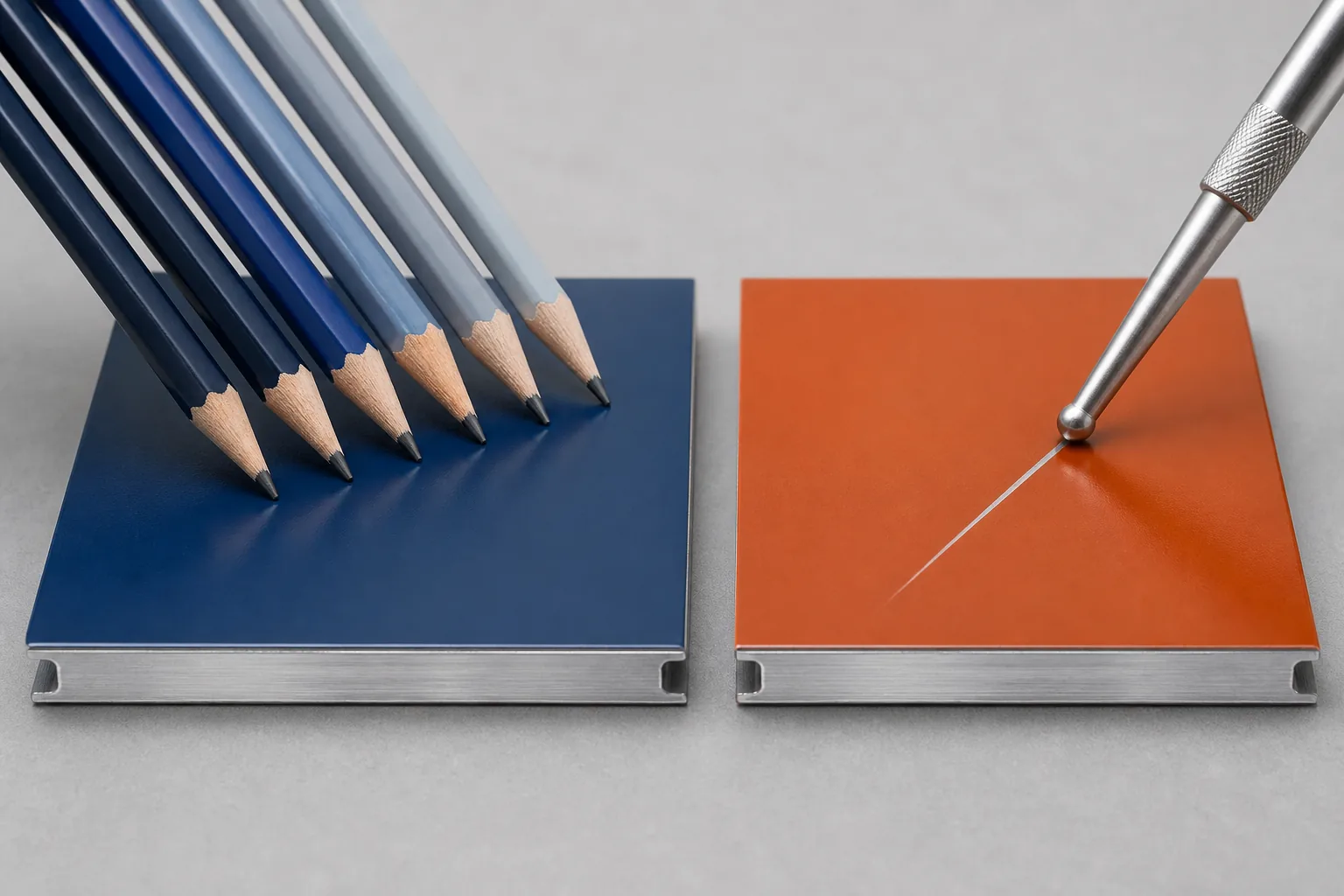
Pencil hardness and stylus scratching answer different questions
EN 13523-4:2014 determines the relative hardness of an organic coating on a metallic substrate using pencils of known hardness. The method can also be used on textured surfaces, but its uncertainty increases as texture becomes more pronounced. ASTM D3363-22 likewise describes a rapid relative ranking and warns that pencil manufacturer, batch and substrate can affect results; for purchase agreements it recommends agreed referee pencils.
BS EN 13523-12:2024 instead addresses resistance to penetration by scratching with a needle. Its scope creates another boundary for thin aluminium: the stylus can deform the substrate rather than simply penetrate the coating, so the report must distinguish coating failure from panel deformation. Neither result automatically predicts every rub, gouge, abrasion or forming mark in service.
Write the acceptance clause as a complete measurement
- Identify the visible face, coating construction, substrate alloy/temper and gauge, specimen source and conditioning.
- Name the current agreed method and version; do not write only ‘pencil hardness’ or ‘scratch resistant’. If parties use another method, define it explicitly.
- Record the tool or pencil set, direction, number and location of readings, endpoint definition and whether the substrate bent or the coating was penetrated.
- State the acceptance limit, repeat or referee procedure, and what happens when visual judgement conflicts with the numerical or ranked result.
- For process-related marks, approve a same-construction first piece and retain photographs, tool settings and the sample; re-review when the coating, substrate, film, tool or route changes.
Qihao perspective: protect the finished face as a process input
From a color-coated aluminium manufacturing and process-communication perspective, ‘2H hardness required’ is incomplete when the actual concern is roll marks, stacking rub or a sliding guide. The same result can sit beside very different tool surfaces, clearances, protection films and handling routes. Naming the damage event usually prevents more disagreement than raising an isolated hardness grade.
Qihao recommends sending the part or profile drawing, visible face, coating and colour, gauge, downstream route, contact points, packaging plan and the defect that must be prevented. That lets the material check and representative process trial be reviewed together before batch release.
This is a marked Qihao perspective based on public standards information and general manufacturing practice. It does not promise a universal hardness grade, scratch load or damage-free result for a specific order; the confirmed specification and representative approval remain controlling.
Sources
- BS EN 13523-12:2024 Coil coated metals — Test methods — Resistance to scratchingBritish Standards Institution · 2024
- EN 13523-4:2014 Coil coated metals — Test methods — Pencil hardnessDIN Media · 2014
- ASTM D3363-22 Standard Test Method for Film Hardness by Pencil TestASTM International · 2022
- European coil-coated metal test methodsEuropean Coil Coating Association · Accessed 20 August 2026
Frequently asked questions
Does a higher pencil-hardness grade prove better scratch resistance?
Not across every damage mechanism. Pencil hardness is a relative result under a named method. A pointed scratch, repeated rubbing, stacking mark and forming-tool contact use different loads and contact geometries, so select evidence for the actual risk.
Can ASTM D3363 and EN 13523-4 results be compared directly?
Do not assume equivalence from the shared pencil scale. State the method, specimen, conditioning, pencil source and endpoint, and use an agreed referee procedure when results form part of a purchase agreement.
Why does substrate thickness matter in a scratch test?
A thin aluminium specimen can deform under a stylus. The report must distinguish substrate deformation from penetration or failure of the organic coating and follow the selected method's specimen requirements.
What should a buyer provide for a scratch-risk review?
Provide the visible face, coating and colour, substrate and gauge, part or profile drawing, forming and handling route, contact points, protection or packaging plan, expected defect and required release evidence.
Related product and technical review
This article provides general information. Product availability and application-specific performance require technical confirmation.