
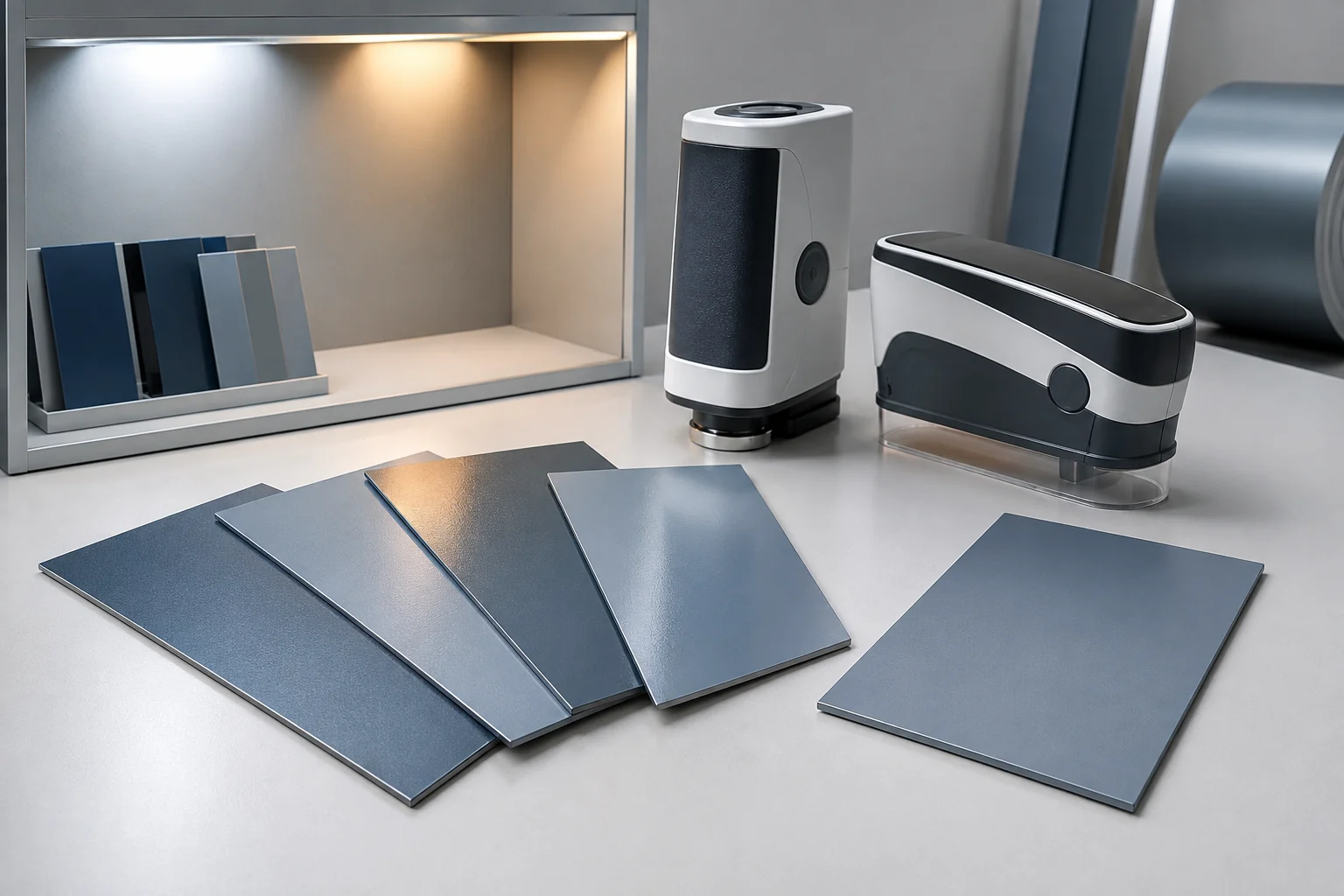
The short answer: freeze the reference, method and decision rule together
A usable order should identify the approved physical master or agreed reference range, the full coating system and surface effect, the permitted colour and gloss variation, the measurement and visual-comparison conditions, the sampling locations and the action for an out-of-limit result. A RAL or other colour code is useful design communication, but it does not by itself define the actual coated-aluminium reference, gloss, texture, viewing direction or acceptable lot variation.
BS EN 13523-3:2024 provides instrumental procedures for comparing an organic coating on metal with a reference using CIELAB colour difference and for assessing metamerism by illuminant. It explicitly does not establish the reference or acceptable tolerance, and it excludes several special-effect finishes from the ordinary method. Those commercial decisions therefore belong in the enquiry and order.
Build an appearance-control sheet before approving production
| Control field | What the buyer and supplier should agree |
|---|---|
| Reference identity | Physical master, reference-panel ID and revision, supplier and buyer copies, approval date, protected storage, replacement and expiry route. |
| Product construction | Alloy/temper, gauge, pretreatment, primer/topcoat/backcoat, resin system, pigment or effect, texture, nominal gloss and intended formed orientation. |
| Colour measurement | Standard and edition, colour space and difference equation, illuminant, observer, instrument geometry, aperture, calibration, specimen backing, direction and number/location of readings. |
| Gloss measurement | Standard and edition, measurement angle, instrument verification, flat or representative specimen, direction, readings and separate acceptance limit. |
| Visual comparison | Light source or booth, viewing geometry and distance, panel adjacency and orientation, observer expectations, permissible shade range and treatment of metamerism. |
| Lot decision | Lot definition, coil and position sampling, within-coil and between-coil limits, pass/hold/retest action, retained samples and dispute laboratory or joint review. |
A ΔE result is meaningful only with its calculation and measurement conditions
ISO/CIE 11664-4:2019 defines the CIE 1976 L*a*b* colour space and methods for calculating Euclidean colour difference. ASTM D2244-25 covers several colour-difference and tolerance calculations and warns that results from different colour-scale systems should not be treated as interchangeable. A purchase limit should therefore name the equation—such as ΔE*ab or ΔE00—rather than writing only 'ΔE'.
Record the component direction as well as the total difference when it matters. Two samples can have the same total numerical difference while one is lighter and the other shifts toward a different hue. Instrument geometry, illuminant, observer, aperture, surface direction, backing and the averaging rule also affect whether results can be compared across laboratories.
Keep colour, gloss, texture and metamerism as separate checks
| Appearance question | Evidence route |
|---|---|
| Is a smooth solid colour close to the approved master? | Use the agreed instrumental colour method plus controlled visual comparison against the same traceable reference. |
| Will adjacent panels look uniform? | Check production samples side by side in the installed orientation; include within-coil, coil-to-coil and replacement-batch rules where adjacency matters. |
| Does the sheen match? | Measure gloss with the agreed angle and specimen condition under BS EN 13523-2 or the specified equivalent; do not hide gloss variation inside a colour limit. |
| Does the match change under another light source? | Assess metamerism using the agreed illuminants and visual conditions; a match under one booth light does not guarantee a spectral match. |
| Is the finish metallic, pearlescent, textured or directional? | Agree representative panels, orientation and multi-angle or specialist evaluation as applicable; do not force an ordinary single-angle ΔE rule onto an unsuitable effect. |
Use a five-step approval and release workflow
- Define the application, adjacent materials, viewing distance, installed direction, expected lighting, replacement strategy and how visible a mismatch would be.
- Approve and identify representative physical masters for colour, gloss and texture; keep protected supplier and buyer copies linked to the specification revision.
- Freeze the instrumental and visual protocols, including formula, illuminant, observer, geometry, aperture, gloss angle, backing, direction, readings and conditioning.
- Agree first-production and lot sampling across coil width and length, then compare both numerical results and visual appearance before shipment or fabrication.
- If a result is outside the agreed rule, hold the affected identity, retain samples and use the named repeat or joint-review route before concession, rework or rejection.
Qihao perspective: approve an appearance system, not a colour label
From a coil-coating and quality-communication perspective, the most stable approval links the master panel to the actual substrate, pretreatment, coating layers, colour, gloss, texture and production direction. That prevents a digital colour value, printed card or resin-family name from silently becoming the only production reference.
For technical review, send the application and lighting, colour reference and physical master status, alloy/temper and gauge, coating build, gloss and texture, forming direction, visible adjacency, colour equation and instrument settings, visual-review conditions, lot size, sampling and action limits. Order-specific capability and tolerances remain subject to written review; this guide does not promise a universal ΔE or gloss value for every finish.
Boundaries
This workflow supports procurement and appearance control for prepainted aluminium coil and sheet. It does not convert colour difference into weathering life, guarantee that instruments predict every visual judgement, or make special-effect finishes comparable by one number. Final acceptance should follow the confirmed order, approved masters and method suitable for the actual surface.
Sources
- BS EN 13523-3:2024 Coil coated metals — Colour difference and metamerism — Instrumental comparisonBritish Standards Institution · 2024-05-31
- BS EN 13523-2:2021 Coil coated metals — Test methods — GlossBritish Standards Institution · 2021-10-31
- ISO/CIE 11664-4:2019 Colorimetry — CIE 1976 L*a*b* colour spaceInternational Organization for Standardization · 2019-06
- ASTM D2244-25 Calculation of color tolerances and color differences from instrumentally measured color coordinatesASTM International · 2025
- Colour assessment in coil coatingEuropean Coil Coating Association · Accessed 2026
Frequently asked questions
Is a RAL number enough to order prepainted aluminium?
No. Also approve the actual reference, gloss, texture, coating build, viewing direction, measurement method, tolerance, sampling and visual-review conditions.
Can ΔE*ab and ΔE00 limits be compared directly?
No. They use different calculations. State the colour space, equation and complete measurement conditions, and compare results only under the agreed method.
Why can two panels pass a colour reading but still look different?
Gloss, texture, directionality, curvature, surrounding colours, lighting and metamerism can change appearance. Use controlled visual comparison alongside the suitable instrumental checks.
Should metallic or textured finishes use the same colour tolerance as smooth solid colours?
Not automatically. Agree a method suited to the effect, including panel orientation, viewing conditions and any specialist or multi-angle measurement needed.
What should be sent for a colour-match technical review?
Send the application, approved reference or physical sample, substrate and coating build, gloss/texture, forming and viewing direction, lighting, measurement protocol, quantity, sampling and acceptance action.
Related product and technical review
This article provides general information. Product availability and application-specific performance require technical confirmation.