
The short answer: define each layer’s job before comparing paint names
Prepainted aluminium is not simply a colour sprayed onto a sheet. In coil coating, a flat aluminium strip is cleaned and surface-treated, then receives primer, topcoat or backside coating as required by the product design. The final result is a combined effect of the substrate, interface and organic coating system.
A usable enquiry or technical agreement should therefore separate the front and back: alloy and temper, thickness, pretreatment, primer and topcoat system, backcoat purpose, target dry-film thickness, colour and gloss, forming or bonding route, and acceptance methods. One resin name or one total-thickness figure is not enough to judge suitability.
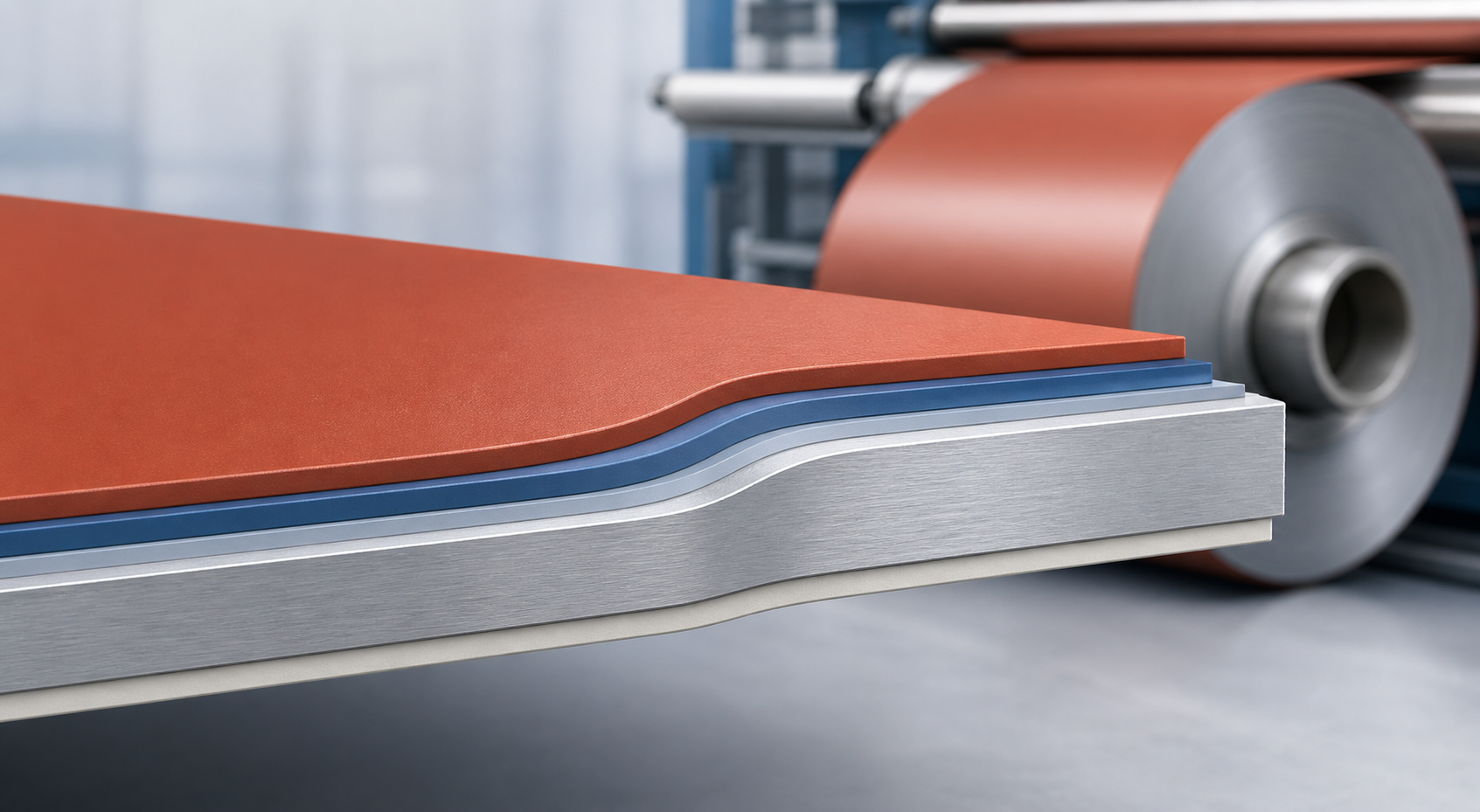
What layers are present in prepainted aluminium
The NCCA describes coil coating as a continuous sequence of cleaning, chemical pretreatment, primer, cure, topcoat, a second cure and recoiling. The ECCA likewise describes coating systems as products built from layers. A real product may be single- or double-sided, with one or several coats, so the table is a communication framework rather than a fixed formula for every order.
| Layer | Main job and discussion point |
|---|---|
| Aluminium substrate | Provides thickness, strength, ductility and baseline corrosion resistance; alloy, temper, surface condition and gauge affect forming and coating performance |
| Pretreatment | Conditions the metal surface and creates a stable interface for later coatings; confirm the system, cleanliness and compatibility with the primer |
| Primer | Links pretreatment to the topcoat, supports intercoat adhesion and contributes to the overall protective system; it should not be hidden behind a finish-coat name |
| Front-side topcoat | Creates the visible finish and carries colour, gloss, weathering, stain or other service-surface requirements; compare it against the use case |
| Backcoat | Is selected for backside exposure, forming, bonding or assembly; its chemistry and thickness may differ from the front side |
Primer, topcoat and backcoat do different work
The primer is the critical link between pretreatment and the finish. If the interface is unstable, the problem may only appear after forming, humidity, corrosion exposure or cleaning. The topcoat more visibly controls appearance and surface-use properties. The backcoat is less visible, but on sandwich panels, equipment housings, interior components or bonded parts its formulation and surface condition can determine assembly performance.
| Coating | What to ask during specification |
|---|---|
| Primer | Is it compatible with the pretreatment and topcoat? Is the target improved adhesion, corrosion protection, forming flexibility or a combination? How are cure and intercoat defects judged? |
| Topcoat | What will the visible surface face? Which of colour, gloss, weathering, staining, chemical exposure and forming performance has priority? |
| Backcoat | Will the reverse side be visible or exposed? Will it be folded, stamped, laminated, foamed, bonded or placed against another material? |
Why “more film thickness is better” is incomplete
Dry-film thickness is an important quality characteristic, but it is a measurement—not a substitute for coating function. The same total thickness can come from different primer, topcoat and backcoat allocations. Different methods can also represent an average, maximum, minimum or total thickness. For textured finishes, agree the method, instrument, calibration, measurement points and acceptance rule in advance.
BS EN 13523-1:2024 lists magnetic induction, eddy current, micrometre, optical and ruggedised optical-interference methods for dry-film thickness. It also explains that readings on textured coatings can have different meanings depending on the method. A sound incoming-inspection plan therefore states which face is measured, by which method, at which points, and how averages and outliers are handled.
A five-step procurement and acceptance checklist
- Map the real part’s front and back: identify visible faces, adhesive or core contact, bends, stampings and assembly interfaces.
- State alloy and temper, gauge and width, pretreatment, front and back coating layers, colour, gloss, target dry-film thickness and protective-film requirements separately.
- Tell the coater about forming, bonding, lamination, cleaning and service exposure; do not use a broad label such as “architectural” or “industrial” as a process specification.
- Agree a reference panel and same-lot trial. Inspect appearance, colour, gloss, film thickness, adhesion, flexibility and backside bonding or assembly performance as separate items, with coil and measurement records.
- When a defect appears, locate it in the stack: surface loss of gloss, topcoat cracking, intercoat delamination, exposed substrate or backside incompatibility require different investigations. Do not use total thickness to explain every failure.
Which layer should you check first when a defect appears
| Field clue | First factors to verify |
|---|---|
| Variation in colour or gloss | Lot continuity, paint change, cure state, measurement illuminant and surface texture; first separate visual variation from measured colour difference |
| Exposed substrate or continuous fine cracks after forming | Bend radius, direction, temperature, topcoat flexibility, total film thickness and substrate condition; record cracks separately from delamination |
| Local bubbles or sheet-like peeling | Cleaning and pretreatment, primer adhesion, cure and moisture/corrosion exposure; trace position, lot and environment |
| Backside bonding or lamination failure | Backcoat chemistry, surface cleanliness, adhesive system, pressure and cure; front-side topcoat performance is not a substitute |
| Use failure despite an in-spec thickness result | Measurement method and locations, layer allocation, cure, substrate, process window and service environment; confirm that the specification covers the actual failure mode |
Qihao perspective: turn the coating stack into traceable process language
From the perspective of Shandong Qihao as a prepainted aluminium manufacturer, many coating disputes are not caused by a lack of instruments. They start with an order that states a colour and coating name but does not define the front and back use, forming route, bonding partner or acceptance method. Separating primer, topcoat and backcoat gives material selection, coil-coating control and downstream fabrication a common problem statement.
Qihao recommends keeping a first-article record that matches the end use: substrate lot, coating layers, film-thickness points, cure conditions, forming or bonding parameters, defect photographs and release decision. A change in paint, substrate, supplier or processing equipment should be treated as a technical change requiring renewed confirmation.
This Qihao perspective is based on public industry material, standard information and general manufacturing practice. It is an observation and recommendation, not a promise about a particular formulation, lot, certification or service life. The final coating system should be confirmed by the material supplier, paint supplier and application team against the real environment.
Boundary of use: a layer map does not replace project validation
Prepainted aluminium products can use different resin, pigment, pretreatment, primer, topcoat and backcoat combinations. Exterior architecture, interiors, equipment housings, composite panels and industrial parts also impose different requirements. This article provides a procurement and process framework; it does not set a universal film thickness, service life or weathering class.
Where a project involves severe exposure, long-term outdoor service, deep forming, specialised bonding or food and hygiene contact, run application-specific trials and compliance checks before ordering. Test standards align the language, but release still depends on the same-lot material, real process and agreed criteria.
Sources
- Coil Coating ProcessNational Coil Coating Association · Accessed 10 August 2026
- Converting to Prepainted MetalNational Coil Coating Association · Accessed 10 August 2026
- About Coil CoatingEuropean Coil Coating Association · Accessed 10 August 2026
- BS EN 13523-1:2024 Coil coated metals — Film thicknessBritish Standards Institution · 2024
Frequently asked questions
Does prepainted aluminium always need a primer?
There is no single answer for every product design. Many coil-coated systems use a primer to link pretreatment to the finish and contribute to protection, but the layer stack depends on the substrate, finish, backside use and project requirements. Ask the supplier to state the front and back layers instead of assuming them.
Does a thicker topcoat or total film always last longer?
Not necessarily. Service performance also depends on resin, pigments, pretreatment, primer adhesion, cure, substrate, environment and fabrication. Film thickness must be read together with the measurement method, layer allocation and applicable specification.
Can the backcoat simply be replaced with the front-side topcoat?
Do not assume so. The reverse side may meet adhesive, core, condensation, assembly-friction or different forming demands. Define the backcoat by its actual function and acceptance conditions.
How should prepainted aluminium film thickness be accepted?
First define the requirement for each face or layer, then agree the instrument, calibration, measurement points, calculation method and outlier treatment. BS EN 13523-1:2024 lists several dry-film methods, and readings on textured finishes should not be mixed without a defined procedure.
This article provides general information. Product availability and application-specific performance require technical confirmation.