
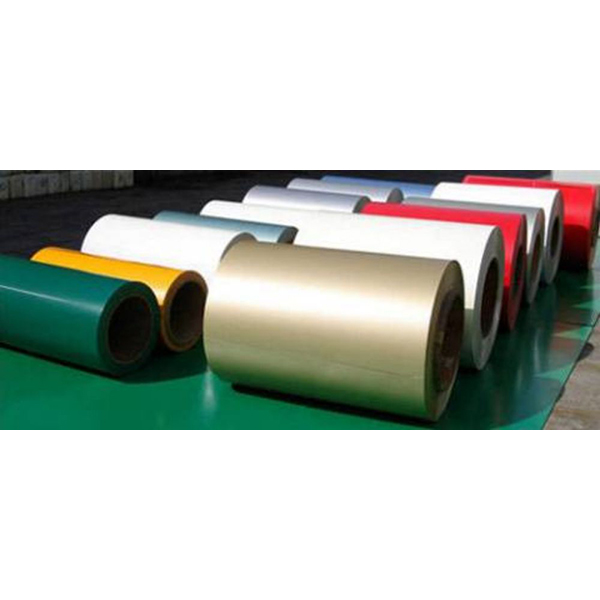
The short answer: the aluminium is coated before fabrication
The National Coil Coating Association describes coil coating as a continuous, highly automated process that coats metal before fabrication. The European Coil Coating Association likewise identifies roller application, pretreatment and curing as central stages in producing prepainted metal.
The timing matters. A coating is created on flat aluminium strip first; fabricators then slit, roll-form, bend, stamp, laminate or assemble the material. The exact line arrangement and coating construction vary by producer, product and order.
What a typical coil-coating line does
| Typical stage | Why the buyer should care |
|---|---|
| Uncoiling and joining | Establishes the alloy, temper, gauge, width and traceability of the aluminium substrate |
| Cleaning and pretreatment | Creates a controlled surface for the coating system; the selected treatment must fit the product design |
| Primer and backing coat | The two faces can serve different functions, so their construction, colour and bonding requirements need separate definition |
| Roll-applied topcoat | Creates the primary appearance and surface function, requiring colour, gloss, texture, film build and reference agreement |
| Oven curing | Brings the coating toward its designed condition; cure control or testing must follow the agreed product plan |
| Cooling, rewinding and packing | Returns the strip to coil form, making coil diameter, weight, surface protection and packaging part of the delivery specification |
A continuous process still needs a measurable specification
Continuity helps repeat cleaning, application and cure under controlled conditions, but it does not replace acceptance criteria. BS EN 13523-0:2021 provides common definitions for the coil-coated metal test series and covers sampling, preparation and conditioning of panels used by many individual methods.
BS EN 1396:2023 provides a specification framework for coil-coated aluminium sheet and strip for general applications. A standard reference must still be checked for scope and combined with the ordered product requirements. Naming a standard does not prove that every test has been completed on a batch, nor does it create certification or a service-life warranty.
Think of prepainted aluminium as a material system
ECCA technical guidance presents prepainted metal as a combination of the metal substrate, cleaning and chemical pretreatment, and multiple coating layers designed to work together. For aluminium, the alloy and temper establish the forming base; pretreatment supports the coating interface; primer, topcoat and backing coat address appearance, processing and service needs.
Two coils can therefore share a colour or generic resin description while differing in substrate, two-sided construction, film build, gloss, texture, fabrication compatibility and acceptance methods. Compare products only after aligning the intended use and specification boundary.
Seven questions for a useful enquiry
- What is the finished component, and will it be used indoors, outdoors or near particular chemicals or moisture?
- Which slitting, roll-forming, bending, stamping, laminating or bonding operations will follow?
- Which aluminium alloy, temper, gauge, width and dimensional tolerances are required?
- What front- and back-side coating construction, colour, gloss, texture and film build are needed?
- Will appearance be approved by colour code, physical master or instrument, and under which conditions?
- Which application-relevant coating, forming, chemical-resistance or weathering tests and methods apply?
- What coil build, protective film, packaging, batch records and delivery conditions must be confirmed?
Qihao perspective: begin with the application, not the paint name
From a color-coated aluminium manufacturer's perspective, asking only whether a colour can be produced rarely creates a stable specification. Qihao recommends explaining the finished use and downstream process first, then converting them into substrate, layer construction, appearance reference and test requirements. This exposes conflicts before sampling and helps buyers compare executable offers.
This is process-based guidance, not a claim that a coating name is automatically suitable for an environment. Published Qihao product ranges support initial discussion only; material selection, performance and acceptance remain subject to order-specific technical confirmation.
Three common misconceptions
| Misconception | A more accurate view |
|---|---|
| The same colour means the same material | Colour is only one attribute; substrate, layers, gloss, texture, film build and performance requirements may differ |
| A thicker coating must last longer | Pretreatment, coating chemistry, layer interaction, cure, exposure and design also influence durability |
| Writing polyester or PVDF completes the specification | A resin family cannot replace the product construction, use boundary, physical reference, test methods and acceptance criteria |
Sources
- About Coil CoatingEuropean Coil Coating Association · Accessed 2026-08-03
- Converting to Prepainted Metal — Coil Coating ProcessNational Coil Coating Association · Accessed 2026-08-03
- BS EN 1396:2023 Aluminium and aluminium alloys — Coil coated sheet and stripBritish Standards Institution · 2023
- BS EN 13523-0:2021 Coil coated metals — General introductionBritish Standards Institution · 2021-10-31
- European test standards for prepainted metalEuropean Coil Coating Association · Accessed 2026-08-03
Frequently asked questions
Is coil-coated aluminium the same as painting a finished part?
No. Coil coating treats and coats flat aluminium strip before fabrication; post-painting applies a finish after the component has been formed. The process route, edge treatment, design choices and acceptance methods are different.
Can prepainted aluminium still be bent or roll-formed?
Prepainted metal is commonly intended for later fabrication, but suitability for a specific bend, stamp or roll-form depends on substrate, temper, gauge, coating system, radius, tooling and process. Confirm the real use or test a representative sample before ordering.
How should a buyer choose polyester, HDP or PVDF?
Consider indoor or outdoor exposure, ultraviolet and corrosive conditions, appearance retention, forming route, expected service period, project standards and budget together. Do not rank options by resin name or price alone; the product needs technical review.
Why specify the backing coat?
The reverse face may provide protection, identification, lamination or a bonding interface. If only the show face is defined, buyer and supplier may assume different backing colour, construction, film build or compatibility requirements.
This article provides general information. Product availability and application-specific performance require technical confirmation.