
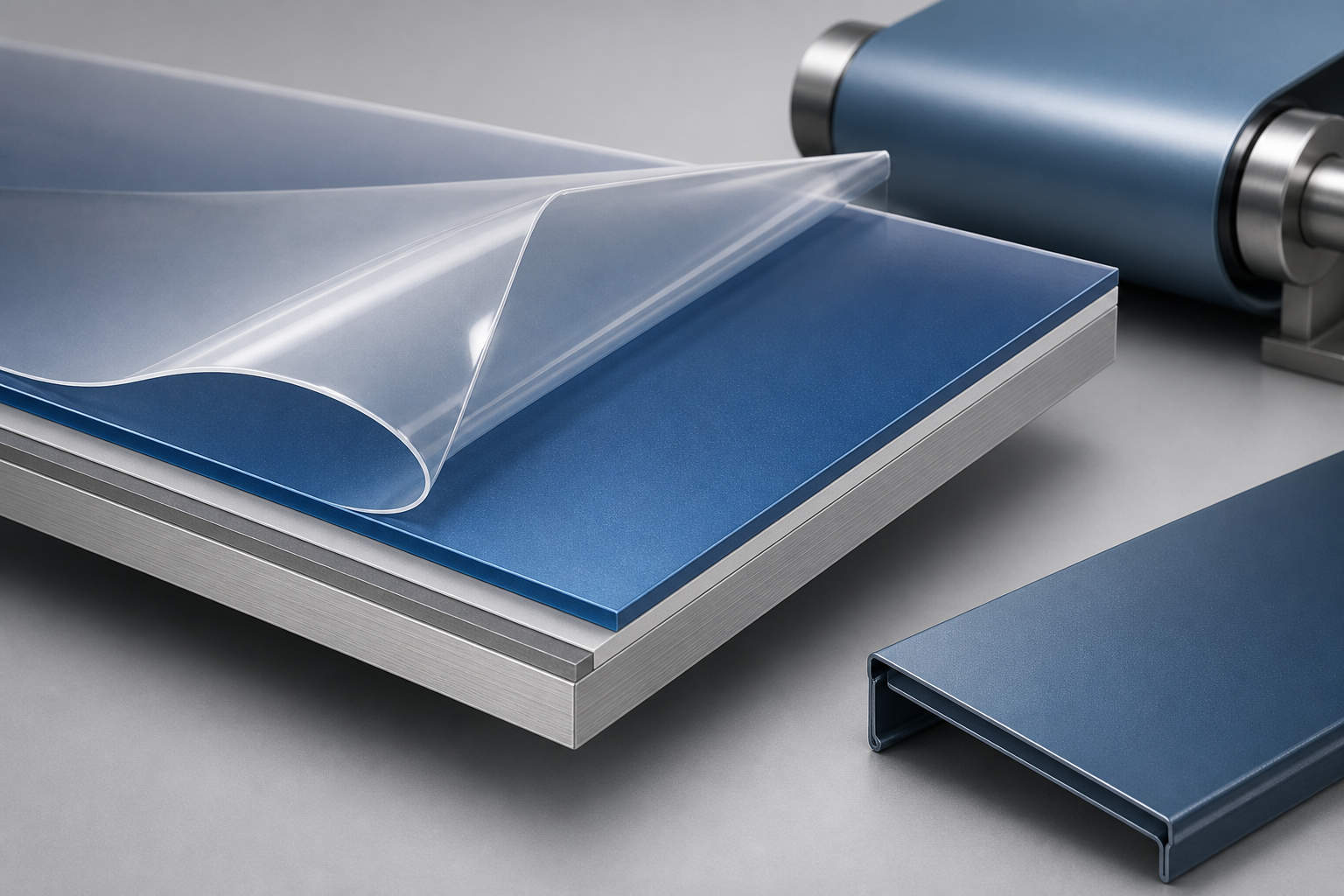
Start with the process the film must survive
Temporary protective film can reduce scratching and handling marks while prepainted aluminium is slit, cut, bent, transported or installed. It also adds an interface between the coating, adhesive, tooling and environment. A film that peels cleanly from one smooth indoor panel may behave differently on a textured, low-gloss or freshly produced coating, or after heat, sunlight, pressure and forming.
The first decision is therefore not simply whether to add film. Define which face needs protection, every process the film will pass through, the storage and exposure sequence, and where removal occurs. If those facts are unknown, a film designation or nominal peel value is not enough to approve a batch.
Use a film-to-process compatibility table
BS EN 13523-17:2019 provides two methods for numerical evaluation of adhesion of strippable films already applied to an organic coating on metal; the preferred method differs for films with and without adhesive. The standard provides a test method, not a universal peel-force limit. The purchaser and supplier still need to agree the product-specific acceptance range and sample state.
| Approval field | What to agree and verify |
|---|---|
| Coated surface | Paint system, colour, gloss or texture, coating age and whether the protected face is decorative, bondable or later printed |
| Film identity | Supplier and grade, carrier and adhesive type, applied face, lot traceability and current technical data |
| Fabrication route | Slitting, shearing, punching, bending, roll forming or lamination; contact points, radius and whether the film stays on during each step |
| Storage and exposure | Packed or unpacked condition, indoor or outdoor stage, expected heat/light/moisture exposure and maximum agreed removal point |
| Adhesion test | Applicable method, specimen preparation, conditioning, peel direction and speed, result unit, acceptable range and test timing |
| Removal acceptance | No unacceptable adhesive residue, coating lift, gloss/colour change, imprint or downstream bonding/printing interference under agreed inspection conditions |
Validate clean removal at the end of the real exposure window
BS EN 1396:2023 treats temporary protective-film properties such as type, thickness, adhesion, formability, tear strength and light fastness as application-dependent matters. NCCA likewise recommends protective films as one way to reduce manufacturing damage while stressing clean tooling, clearances, handling and process selection. These sources support an order-specific trial rather than a one-film-for-all rule.
- Approve the film on a representative panel from the intended coating system, not on bare aluminium or a different finish.
- Record an initial adhesion result and appearance check using the agreed method.
- Expose samples to the representative packed storage, heat/light conditions and fabrication steps without inventing a universal accelerated cycle.
- Remove film at agreed intermediate and latest-use points, then inspect both coating and film for residue, coating transfer, imprint, gloss or colour change.
- Run any downstream bonding, printing or assembly check on the exposed surface when that operation is part of the product route.
Use the symptom to choose the next check
Do not infer one root cause from the symptom alone. For example, coating transfer can reflect excessive film adhesion, a weak coating interface or both. Preserve the affected film, panel, coil and film lot identities so the parties can compare the same evidence chain.
| Observed result | First evidence to compare |
|---|---|
| Film lifts during cutting or forming | Film/coating match, initial adhesion, contaminated surface, application pressure, edge damage, bend strain and tool contact |
| Film tears or will not peel continuously | Carrier grade, cut edges, peel direction, processing damage, storage/exposure history and removal method |
| Adhesive residue remains | Film lot, exposure duration, heat/light history, coating texture, agreed removal point and supplier compatibility trial |
| Gloss or colour changes after removal | Approved reference panel, lighting and measurement conditions, pressure imprint, coating/adhesive interaction and exposure history |
| Coating lifts with the film | Failure layer, pretreatment and coating adhesion, cure evidence, film adhesion range and whether the panel was representative |
Qihao perspective: make removal a named hand-off point
From a prepainted-aluminium manufacturing and fabrication perspective, protective-film problems often sit between organizations: the coater selects or applies the film, a converter forms the sheet, logistics adds storage exposure, and an installer removes it. The purchase file should name who removes the film, at which process step and what evidence closes the hand-off.
Qihao recommends approving the coating and film as a combination on a representative sample, then recording the film grade and lot beside the aluminium coil and coating identity. Ask for the end use, protected face, paint finish, fabrication steps, storage/exposure sequence and planned removal point during technical review.
This is a marked Qihao perspective based on public standards and general manufacturing practice. It is not a universal adhesion range, removal deadline or assurance that a film suits a particular order without a representative trial.
Sources
- BS EN 13523-17:2019 Coil coated metals — Adhesion of strippable filmsBritish Standards Institution · 2019
- BS EN 1396:2023 Aluminium and aluminium alloys — Coil coated sheet and stripBritish Standards Institution · 2023
- 10 Tips for Processing Prepainted MetalNational Coil Coating Association · 2021
Frequently asked questions
Does every prepainted aluminium panel need protective film?
No. The need depends on the decorative face, handling risk, tooling, packaging, fabrication and installation route. Film adds cost and another material interface, so approve it only when it controls a defined risk.
Can one peel-strength value approve the film?
Not by itself. Record the film and coating identities, specimen conditioning, test method, peel conditions, result unit and timing. Also verify clean removal and the exposed coating after representative processing and ageing.
How long can protective film stay on prepainted aluminium?
There is no universal period. The film supplier, coating supplier and processor should agree a maximum removal point for the actual film/coating combination and exposure route, then validate it on representative samples.
What information should be sent for technical review?
Send the paint finish and protected face, film requirement or current grade, fabrication steps, storage and exposure sequence, planned removal point, downstream bonding or printing needs, and the acceptance method for residue and appearance.
Related product and technical review
This article provides general information. Product availability and application-specific performance require technical confirmation.