
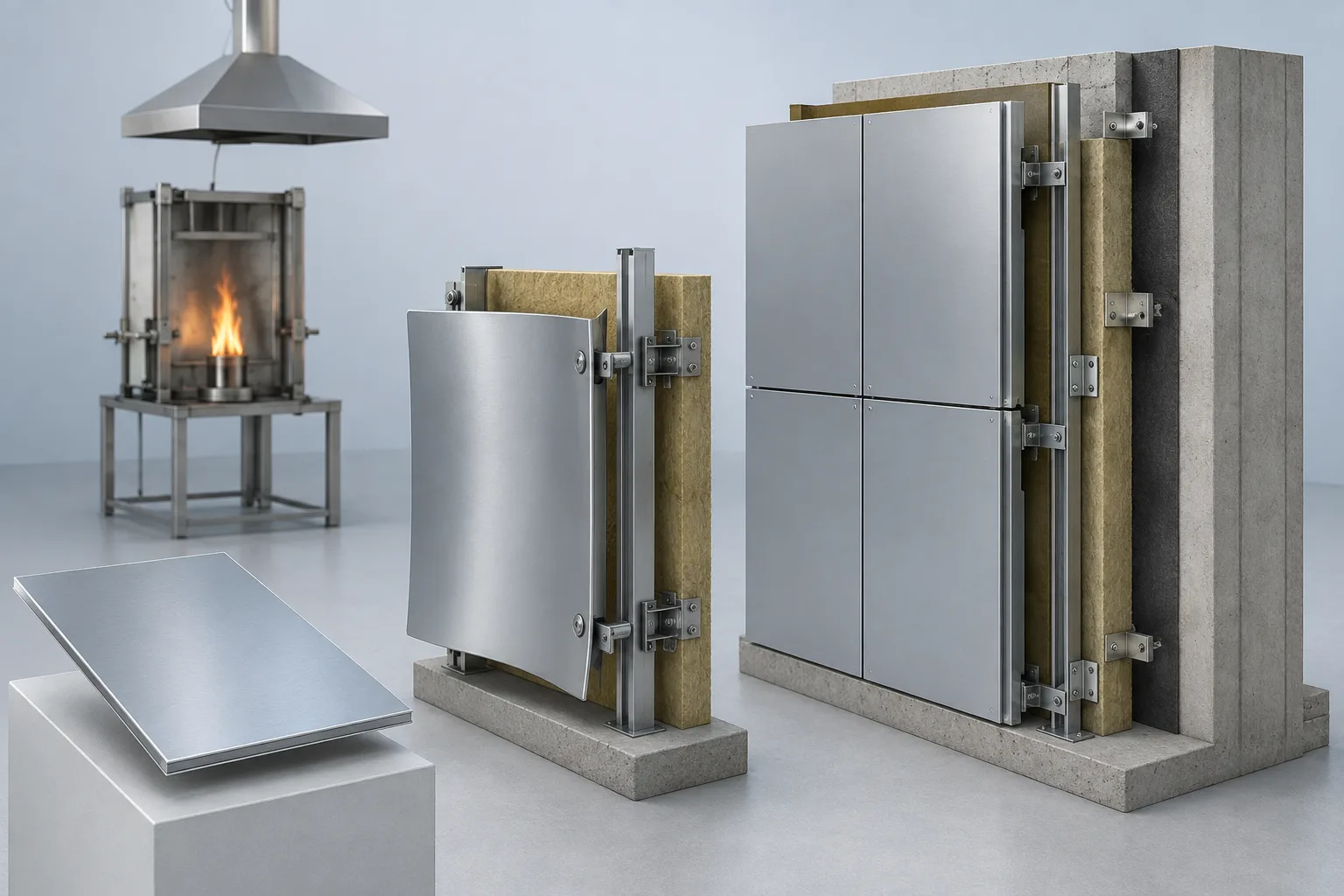
The short answer: request evidence for the product and end-use construction you will actually install
A buyer should not release prepainted solid aluminium for a regulated building application from a generic material statement alone. The request should identify the exact product and coating build, the panel geometry and thickness, the supporting construction and insulation where relevant, the destination market and project use, the required fire characteristic, the applicable classification edition, and the report, classification or declaration that the approving party will accept.
BS EN 13501-1:2018 classifies construction products from reaction-to-fire test data and explicitly considers products in relation to end-use application. Commission Delegated Regulation (EU) 2016/364 sets the EU reaction-to-fire classes and their test criteria. Neither source turns an uncoated-aluminium fact, a substrate certificate or an unrelated panel report into approval for every coated product and facade build-up.
Use a three-level evidence ladder
| Evidence level | Question it can answer—and what it cannot |
|---|---|
| Material and coated sheet | Identifies the solid aluminium substrate, coating build and tested product configuration. It does not by itself cover a different coating, composite core, panel geometry or wall assembly. |
| Formed cladding product | Covers the named panel or profile, thickness range, joints, fixings and declared end use within the report's field of application. It does not automatically approve substituted components or the complete facade. |
| Wall or facade system | Addresses the tested or assessed construction: outer skin, cavity, barriers, insulation, membranes, subframe, fixings, joints and substrate. Its result belongs to that construction and stated variations. |
Reaction to fire is not fire resistance
Reaction to fire describes contribution to fire development and may include smoke and flaming-droplet classifications. Fire resistance concerns the ability of a building element to maintain specified functions during fire exposure. BS EN 13501-2:2023 classifies products and building elements from fire-resistance and smoke-control test data, including walls, roofs, curtain walls and external walls.
Therefore a reaction-to-fire class should not be rewritten as a number of fire-resistance minutes, and a fire-resistance result for one wall construction should not be presented as an intrinsic property of a coil. If the project asks about external fire spread, cavity barriers, roof performance or a jurisdiction-specific facade test, treat that as a separate system requirement and obtain the exact acceptance route from the responsible fire designer or authority.
A buyer's evidence matrix for the RFQ and submittal
| Specify | Minimum decision information |
|---|---|
| Product identity | Solid aluminium or composite product; alloy/temper; metal and coated thickness; primer, topcoat and backcoat; panel/profile designation and manufacturing route. |
| End-use construction | Interior/exterior use; wall, soffit or roof; open or closed joints; cavity, insulation, membrane, subframe, fixings, substrate and fire barriers. |
| Required characteristic | Reaction to fire, fire resistance, external fire performance or another jurisdiction-specific requirement—do not combine them under 'fireproof'. |
| Evidence route | Named regulation/code and edition; test and classification standards; report owner and laboratory; classification/assessment number; declaration or approval required. |
| Applicability check | Tested specimen and mounting; covered product family and variations; thickness, colour/coating, joints, fixings and substrates; exclusions and expiry/review status. |
| Change control | Who reviews a changed coating, gauge, supplier, insulation, fixing, cavity or panel geometry, and whether new assessment or testing is required before release. |
Five steps before approving a fire-related submittal
- Classify the deliverable: bare or coated solid sheet, fabricated panel, composite product, cassette, roof product or complete wall system.
- Ask the project fire designer or approving authority to name the required characteristic, classification system, edition and acceptable evidence route for the destination.
- Compare the proposed product and installed construction with the report's tested specimen and field of application, including coating, thickness, mounting, joints, cavity, insulation and fixings.
- Record every difference. Obtain a permitted extended application, technical assessment or new test where the governing route requires it; do not close gaps with a supplier statement alone.
- Freeze accepted documents and component identities before production and installation, then route later substitutions back through the named reviewer.
Qihao perspective: start the fire review before colour and fabrication are frozen
From a prepainted-aluminium manufacturing and specification-communication perspective, the most useful first question is not 'Is aluminium fireproof?' but 'Which exact supplied product and installed build-up must satisfy which destination requirement?' That question exposes whether the buyer needs sheet identity, a product classification, a declaration, or evidence for the complete wall or roof system.
For technical review, send the destination and project use, whether the product is solid sheet or another construction, alloy/temper, metal thickness, full coating build, panel geometry, fixing and joint concept, insulation/cavity components, required classification and the approving party's document list. Qihao can review the material and manufacturing inputs for a specific enquiry, but no fire class, system approval or regulatory suitability is promised unless the corresponding current evidence is identified and confirmed for that order and end use.
Market and scope boundaries
The EU construction-products framework communicates performance through declarations tied to applicable harmonised technical routes, while project and national rules determine the performance required for the intended use. Other markets use different classifications and approval paths. This guide is a procurement framework, not a code opinion, fire-engineering assessment or statement that classifications are interchangeable across jurisdictions.
Sources
- BS EN 13501-1:2018 Fire classification — Classification using data from reaction to fire testsBritish Standards Institution · 2019-01-31
- BS EN 13501-2:2023 Fire classification — Fire resistance and smoke control testsBritish Standards Institution · 2023-06-30
- Commission Delegated Regulation (EU) 2016/364 on reaction-to-fire classificationEuropean Union · 2016-03-15
- Regulation (EU) 2024/3110 laying down harmonised rules for the marketing of construction productsEuropean Union · 2024-12-18
Frequently asked questions
Is solid aluminium automatically non-combustible after coil coating?
Do not decide from the substrate alone. The classification must apply to the actual coated product, specimen and end-use conditions under the destination's accepted route.
Does an A1 or A2 reaction-to-fire class prove 60 minutes of fire resistance?
No. Reaction to fire and fire resistance are different characteristics with different tests and classifications. A minutes-based requirement needs evidence for the relevant building element and construction.
Can a solid-aluminium report be used for aluminium composite material?
Not without an applicable assessment route. A composite core changes the product construction; use evidence that covers the exact composite product and intended installation.
Does changing colour or coating require a new fire review?
Check the report's covered product family and field of application. A change may be covered, require documented assessment, or fall outside the evidence; the report owner and approving party should decide before release.
What should be sent with a fire-performance enquiry?
Send the market and building use, product construction, alloy/temper, thickness, coating build, panel and joint design, supporting wall/roof components, required characteristic and class, named code edition and approval-document list.
Related product and technical review
This article provides general information. Product availability and application-specific performance require technical confirmation.